
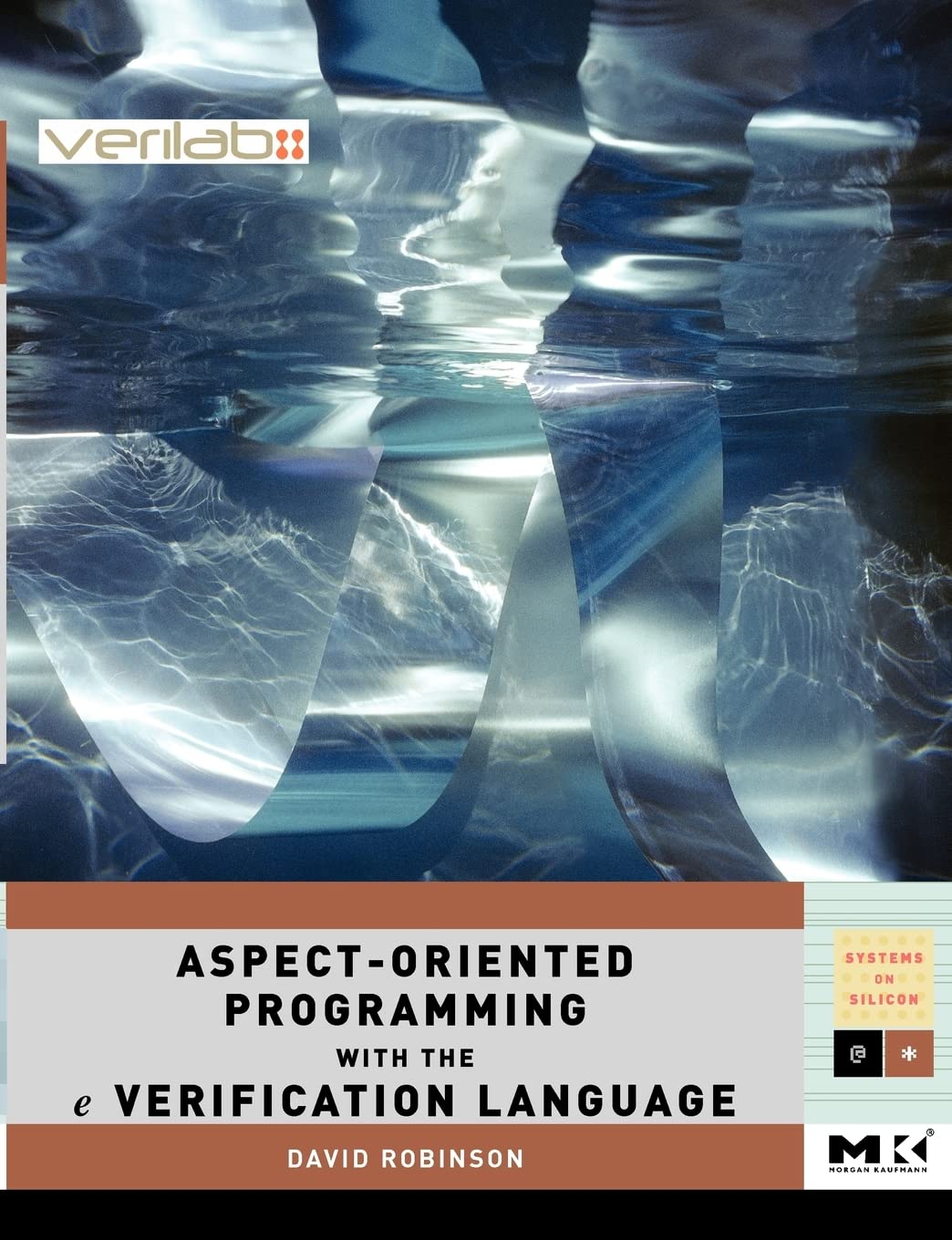
Aspect-Oriented Programming with the e Verification Language: A Pragmatic Guide for Testbench Developers by David Robins
Inclusive of all applicable taxes. FREE shipping on all orders.
Available Offers
- 🚚Free Delivery — Free shipping on all orders
- 💵Cash on Delivery — Pay when your order arrives
- ↩️15-Day Easy Returns — Hassle-free return policy
- 🔒Cash on Delivery — Pay safely when your order arrives
Check Delivery
Product Description
Introduction
Verification engineers and testbench developers often face the challenge of managing complex, evolving codebases. Traditional object-oriented programming can sometimes fall short when it comes to cleanly separating concerns and enabling flexible, reusable verification environments. Aspect-Oriented Programming with the e Verification Language: A Pragmatic Guide for Testbench Developers by David Robinson offers a refreshing solution. This book demystifies aspect-oriented programming (AOP) in the context of the e language, providing practical techniques to write cleaner, more modular, and easily maintainable verification code. Whether you are a student exploring hardware verification or a seasoned professional, this guide helps you harness the power of AOP to simplify your workflow and boost productivity.
Book Overview
Published by Morgan Kaufmann Publishers, this hardcover edition serves as a comprehensive yet accessible resource for anyone working with the e verification language. The book bridges the gap between theoretical AOP concepts and real-world testbench development. Instead of diving into abstract definitions, David Robinson uses a pragmatic, example-driven approach to show how aspects can be used to organize code by functionality, layers, components, protocols, and coverage. Readers will learn to create plug-and-play environments where adding or removing features does not require modifying existing code. The book is written in a conversational tone, making complex ideas easy to grasp, and it includes numerous code snippets and case studies drawn from actual verification projects.
Key Highlights
- Practical focus: Emphasis on real-world examples from verification environments rather than theoretical discussions.
- Plug-and-play design: Learn to build modular components like debug modules and coverage collectors that can be added or removed without altering core code.
- Organize by concerns: Move beyond class-based organization and structure code around what matters—functionality, protocols, checking, and coverage.
- Clear explanations: Complex AOP concepts are broken down into simple, actionable steps suitable for beginners and experts alike.
- Expert authorship: Written by David Robinson, a seasoned verification engineer with years of hands-on experience in the field.
Inside the Book
The book is structured to take you from foundational AOP principles to advanced implementation strategies. Early chapters introduce the core idea of aspects and how they differ from traditional OOP. Subsequent chapters delve into practical topics such as weaving aspects into existing code, managing aspect precedence, and using pointcuts to capture join points effectively. You will also find dedicated sections on creating reusable aspect libraries, debugging with aspects, and integrating AOP with functional coverage and assertions. Each chapter includes exercises and thought-provoking questions to reinforce learning. The final chapters present complete case studies that demonstrate how AOP can transform a messy, monolithic verification environment into a clean, maintainable system.
Key Topics
- Fundamentals of aspect-oriented programming and the e language
- Defining and using aspects, pointcuts, and advice
- Organizing verification code by functional concerns
- Building pluggable debug and monitoring modules
- Handling cross-cutting concerns like logging, coverage, and error injection
- Combining AOP with object-oriented techniques for maximum flexibility
- Real-world case studies from industry verification projects
Reader Benefits
- Reduced development time: Write code that is easier to extend and modify without breaking existing functionality.
- Better code organization: Keep your verification environments tidy and intuitive by separating concerns cleanly.
- Enhanced reusability: Create aspects that can be reused across multiple projects or teams.
- Simplified debugging: Use aspects to add tracing and logging without cluttering your main code.
- Career growth: Gain a competitive edge by mastering a powerful paradigm that is highly valued in the verification industry.
Learning Outcomes
By the end of this book, you will be able to identify cross-cutting concerns in your verification environments and apply AOP techniques to address them elegantly. You will understand how to design aspects that encapsulate functionality like coverage collection, protocol checking, and debug messaging. You will also learn strategies for managing aspect interactions and precedence to avoid conflicts. Most importantly, you will gain the confidence to build verification frameworks that are truly modular, allowing team members to plug in new features without touching existing code. These skills are directly applicable to modern verification workflows and will make you a more effective and sought-after engineer.
Who Should Read
This book is ideal for verification engineers, testbench developers, and hardware design engineers who use the e language. It is also highly beneficial for students pursuing courses in VLSI design, verification, or computer engineering who want to understand advanced programming paradigms. If you are a software developer transitioning into the hardware verification domain, this guide will help you quickly get up to speed with AOP and the e language. Managers and team leads will also find value in understanding how AOP can improve code maintainability and team productivity.
About the Author
David Robinson is a veteran verification engineer with over two decades of experience in the semiconductor industry. He has worked on complex verification projects for networking, processor, and SoC designs at leading companies. David is known for his ability to translate intricate technical concepts into clear, practical guidance. He has also contributed to the development of the e language and has been an active speaker at verification conferences worldwide. His passion for teaching and his deep understanding of AOP make this book an invaluable resource for anyone serious about verification.
About the Publisher
Morgan Kaufmann Publishers is a respected imprint known for producing high-quality technical books in computer science and engineering. With a focus on practical knowledge and rigorous content, Morgan Kaufmann has been a trusted name among professionals and academics for decades. Their titles are widely used in universities and industry training programs around the world. This book upholds that tradition by offering authoritative, well-researched content that meets the needs of today’s verification engineers.
Conclusion
Aspect-Oriented Programming with the e Verification Language is not just another programming book—it is a practical toolkit for transforming the way you build and manage verification environments. By embracing AOP, you can achieve cleaner code, faster development cycles, and more robust testbenches. David Robinson’s clear writing, real-world examples, and step-by-step guidance make this an essential addition to the library of every verification professional. Order your hardcover copy from Bookshops.in today and start writing verification code that is as elegant as it is powerful.
Quick Summary
Aspect-Oriented Programming with the e Verification Language by David Robinson is a pragmatic guide for testbench developers who want to master AOP in the e language. Unlike traditional OOP approaches, this book teaches you to organize code by functionality, layers, and protocols, making verification environments more flexible and maintainable. Through real-world examples, you will learn to create aspects that handle cross-cutting concerns like coverage, checking, and debugging without cluttering your main code. The book is ideal for Indian VLSI engineers and students looking to advance their skills in functional verification. By buying from Bookshops.in, you get a genuine hardcover edition with fast delivery across India, backed by a trusted online bookstore for technical titles.
Book Highlights
Book Specifications
| ISBN-13 | 9780123742100 |
| ISBN-10 | 0123742102 |
| Publisher | Morgan Kaufmann Publishers In |
| Language | English |
| Dimensions | 19.05 x 1.52 x 23.5 cm |
| Weight | 544 g |
| Category | Languages › C & C++ |
| Genre | Non-fiction |
| Original Language | English |
Frequently Asked Questions
What is the e verification language?
Who is David Robinson?
Is this book suitable for beginners?
Does the book cover only e language?
Can I use this book for university courses?
What is the price in India?
Is there a digital version available?
Does the book include practical examples?
What is the binding of this book?
How is AOP different from OOP in verification?
Will this book help with job interviews?
Can I return the book if damaged?
Readers Also Search For
Customers Also Bought

Programming
Algorithmische Sprache Und Programmentwicklung | by H. Partsch | F. L. Bauer | P. Pepper | Springer | by H. Partsch | F. L. Bauer | P. Pepper | Springer | by H. Partsch | F. L. Bauer | P. Pepper | Springer | by H. Partsch | F. L. Bauer | P. Pepper | Springer | by H. Partsch | F. L. Bauer | P. Pepper | Springer | by H. Partsch | F. L. Bauer | P. Pepper | Springer | by H. Partsch | F. L. Bauer | P. Pepper | Springer | by H. Partsch | F. L. Bauer | P. Pepper | Springer | by H. Partsch | F. L. Bauer
Programming
Distributed Algorithms | by Jean-Claude Bermond | Michel Raynal | Springer | by Jean-Claude Bermond | Michel Raynal | Springer | by Jean-Claude Bermond | Michel Raynal | Springer | by Jean-Claude Bermond | Michel Raynal | Springer | by Jean-Claude Bermond | Michel Raynal | Springer | by Jean-Claude Bermond | Michel Raynal | Springer | by Jean-Claude Bermond | Michel Raynal | Springer | by Jean-Claude Bermond | Michel Raynal | Springer | by Jean-Claude Bermond | Michel Raynal | Springer | by Jean

Programming
Meta-Level Control for Deductive Database Systems | by Helmut Schmidt | Springer | by Helmut Schmidt | Springer | by Helmut Schmidt | Springer | by Helmut Schmidt | Springer | by Helmut Schmidt | Springer | by Helmut Schmidt | Springer | by Helmut Schmidt | Springer | by Helmut Schmidt | Springer | by Helmut Schmidt | Springer | by Helmut Schmidt | Springer | by Helmut Schmidt | Springer | by Helmut Schmidt | Springer | by Helmut Schmidt | Springer | by Helmut Schmidt | Springer | by Helmut Schm
Programming
Java Web Services | by David A. Chappell | Tyler Jewell | O'Reilly Media | by David A. Chappell | Tyler Jewell | O'Reilly Media | by David A. Chappell | Tyler Jewell | O'Reilly Media | by David A. Chappell | Tyler Jewell | O'Reilly Media | by David A. Chappell | Tyler Jewell | O'Reilly Media | by David A. Chappell | Tyler Jewell | O'Reilly Media | by David A. Chappell | Tyler Jewell | O'Reilly Media | by David A. Chappell | Tyler Jewell | O'Reilly Media | by David A. Chappell | Tyler Jewell | O'
Programming
Database in Depth | by Chris J. Date | O'Reilly Media | by Chris J. Date | O'Reilly Media | by Chris J. Date | O'Reilly Media | by Chris J. Date | O'Reilly Media | by Chris J. Date | O'Reilly Media | by Chris J. Date | O'Reilly Media | by Chris J. Date | O'Reilly Media | by Chris J. Date | O'Reilly Media | by Chris J. Date | O'Reilly Media | by Chris J. Date | O'Reilly Media | by Chris J. Date | O'Reilly Media | by Chris J. Date | O'Reilly Media | by Chris J. Date | O'Reilly Media | by Chris J.

Programming
Integration of AI and OR Techniques in Constraint Programming for Combinatorial Optimization Problem | by Nicolas Beldiceanu | Narendra Jussien | Eric Pinson | Springer | by Nicolas Beldiceanu | Narendra Jussien | Eric Pinson | Springer | by Nicolas Beldiceanu | Narendra Jussien | Eric Pinson | Springer | by Nicolas Beldiceanu | Narendra Jussien | Eric Pinson | Springer | by Nicolas Beldiceanu | Narendra Jussien | Eric Pinson | Springer | by Nicolas Beldiceanu | Narendra Jussien | Eric Pinson |
Related Products
View All
Computers & Internet
Modern Full-Stack React Projects by Daniel Bugl
Computers & Internet
Mootools 1.2 Beginner's Guide (English, Jacob Gube)
Computers & Internet
Contemporary Methods for Speech Parameterization (Springerbriefs in Electrical and Computer Engineering / Springerbriefs in Speech Technology)

Computers & Internet
Information Technology and Lawyers | by Arno R. Lodder | Anja Oskamp | Springer | by Arno R. Lodder | Anja Oskamp | Springer | by Arno R. Lodder | Anja Oskamp | Springer | by Arno R. Lodder | Anja Oskamp | Springer | by Arno R. Lodder | Anja Oskamp | Springer | by Arno R. Lodder | Anja Oskamp | Springer | by Arno R. Lodder | Anja Oskamp | Springer | by Arno R. Lodder | Anja Oskamp | Springer | by Arno R. Lodder | Anja Oskamp | Springer | by Arno R. Lodder | Anja Oskamp | Springer | by Arno R. Lo

Computers & Internet
Digital Analysis of Remotely Sensed Imagery | by Jay Gao | McGraw-Hill Companies | by Jay Gao | McGraw-Hill Companies | by Jay Gao | McGraw-Hill Companies | by Jay Gao | McGraw-Hill Companies | by Jay Gao | McGraw-Hill Companies | by Jay Gao | McGraw-Hill Companies | by Jay Gao | McGraw-Hill Companies | by Jay Gao | McGraw-Hill Companies | by Jay Gao | McGraw-Hill Companies | by Jay Gao | McGraw-Hill Companies | by Jay Gao | McGraw-Hill Companies | by Jay Gao | McGraw-Hill Companies | by Jay Gao
Computers & Internet