
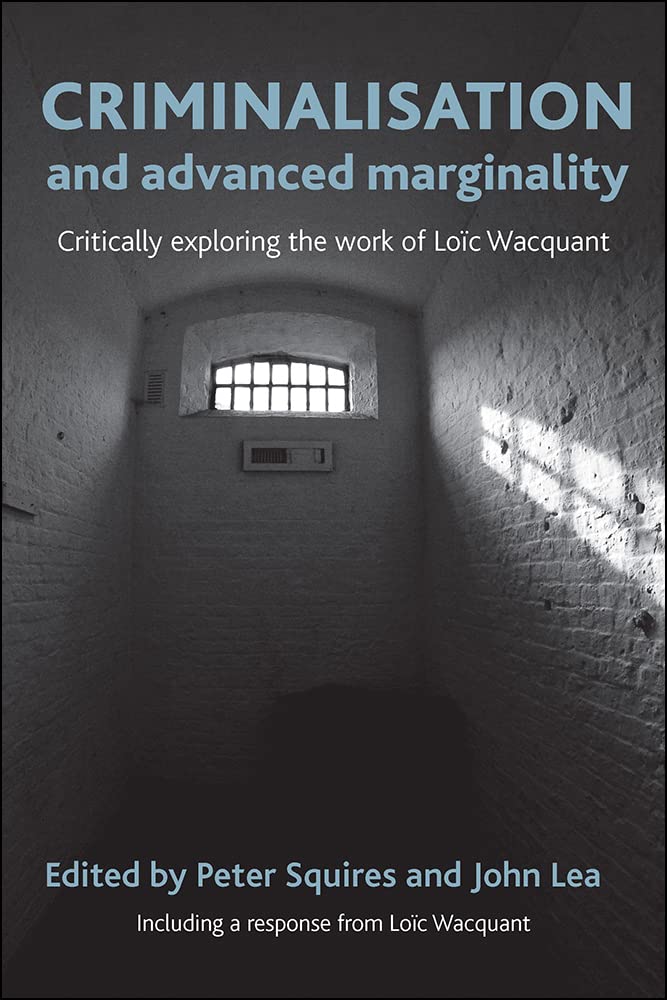
Criminalisation and Advanced Marginality: Critically Exploring the Work of Loïc Wacquant by Peter Squires – A Deep Dive
Inclusive of all applicable taxes. FREE shipping on all orders.
Available Offers
- 🚚Free Delivery — Free shipping on all orders
- 💵Cash on Delivery — Pay when your order arrives
- ↩️15-Day Easy Returns — Hassle-free return policy
- 🔒Cash on Delivery — Pay safely when your order arrives
Check Delivery
Product Description
Introduction
In an era where the boundaries between crime control and social welfare have become increasingly blurred, the work of French sociologist Loïc Wacquant offers a powerful lens through which to examine the punitive turn in contemporary governance. Criminalisation and Advanced Marginality: Critically Exploring the Work of Loic Wacquant, edited by Peter Squires, is the first comprehensive volume to engage critically with Wacquant’s provocative ideas. This hardcover edition, published by Policy Press, brings together leading scholars to dissect, debate, and build upon Wacquant’s influential theories on neoliberalism, penal policy, and the production of urban marginality. For Indian students, researchers, and policy analysts, this book provides a vital framework for understanding how global trends in criminalisation and welfare retrenchment resonate within local contexts.
Book Overview
This collection of essays offers a rigorous yet accessible exploration of Wacquant’s core concepts—from the ‘penal state’ and ‘advanced marginality’ to the criminalisation of poverty and the transformation of the welfare state into a disciplinary apparatus. Each chapter critically examines different facets of Wacquant’s work, including his analysis of the ghetto, the prison, and the neoliberal reordering of state power. The book concludes with a rare and invaluable response from Wacquant himself, addressing the critiques and comments of the contributors. Designed for both newcomers and those already familiar with his writings, this volume serves as both an introduction and a critical companion to one of the most important sociological thinkers of our time.
Key Highlights
- First critical engagement with Loïc Wacquant’s entire body of work on crime, punishment, and marginality.
- Interdisciplinary perspectives from criminology, sociology, political science, and urban studies.
- Original response from Wacquant himself, offering unique insight into his intellectual evolution.
- Global relevance with case studies and examples from Europe, the Americas, and beyond.
- Hardcover edition from Policy Press, a leading academic publisher in social policy.
Inside the Book
The volume is structured around key themes in Wacquant’s scholarship. Early chapters introduce his concepts of ‘advanced marginality’ and the ‘penal state,’ linking them to the rise of neoliberal governance. Subsequent essays delve into the racialisation of punishment, the role of the state in producing urban exclusion, and the erosion of social citizenship. The contributors—including noted criminologists and sociologists—offer both supportive and critical readings, ensuring a balanced and thought-provoking dialogue. The final section features Wacquant’s detailed rejoinder, where he clarifies, defends, and refines his arguments in light of the discussions. This structure makes the book an ideal resource for seminars, graduate courses, and independent study.
Key Topics
- Advanced marginality and the new urban poverty
- Neoliberal penality and the rise of mass incarceration
- Welfare state retrenchment and ‘diswelfare’
- Criminalisation of poverty and social insecurity
- Racial and ethnic stratification in punishment systems
- State power and the shift from social to penal regulation
Reader Benefits
- Deepen your understanding of contemporary criminological theory and its real-world applications.
- Gain critical tools to analyse policies on crime, welfare, and urban governance in India and globally.
- Engage with cutting-edge debates in sociology and social policy through a single, coherent volume.
- Access Wacquant’s own voice in his concluding response, offering a rare behind-the-scenes look at his thinking.
- Strengthen academic writing and argumentation by studying how scholars critique and build on foundational theories.
Learning Outcomes
By reading this book, you will be able to: explain the concept of advanced marginality and its relationship to neoliberalism; critically assess Wacquant’s thesis on the penal state and the criminalisation of poverty; compare different scholarly perspectives on the transformation of welfare into discipline; apply these theoretical insights to contemporary issues such as slum demolition, custodial violence, and social exclusion in India; and formulate your own informed critique of punitive governance models. The book equips you with both knowledge and analytical skills essential for advanced study in criminology, sociology, and public policy.
Who Should Read
This book is essential reading for postgraduate students and researchers in criminology, sociology, social policy, political science, and urban studies. It is also highly relevant for practitioners in law enforcement, social work, and non-governmental organisations working on issues of poverty, justice, and human rights. Indian readers interested in understanding the global forces shaping local realities—such as the expansion of the prison system, the criminalisation of beggary, or the policing of informal settlements—will find Wacquant’s framework both illuminating and challenging. Undergraduate students with a strong background in social theory will also benefit from this accessible yet sophisticated collection.
About the Author
Peter Squires is a Professor of Criminology and Public Policy at the University of Brighton, UK. He has written extensively on youth crime, gun violence, and policing, and has a longstanding interest in the intersections of social inequality and criminal justice. His editorial work brings together a distinguished group of international scholars, each offering a unique perspective on Wacquant’s legacy.
About the Publisher
Policy Press, an imprint of Bristol University Press, is a leading academic publisher specialising in social policy, criminology, and public administration. Known for its rigorous peer review and commitment to socially relevant research, Policy Press has published influential works by scholars such as Loïc Wacquant, David Garland, and John Braithwaite. This hardcover edition reflects the publisher’s dedication to producing high-quality, durable books for academic libraries and serious readers.
Conclusion
Criminalisation and Advanced Marginality is not merely a commentary on Wacquant’s work—it is an invitation to think critically about the direction of modern governance. As India grapples with its own dilemmas of crime, poverty, and state power, this book offers a vital theoretical compass. Whether you are a student, teacher, researcher, or activist, this volume will challenge your assumptions and enrich your understanding of the punitive turn in contemporary societies. Order your hardcover copy today from Bookshops.in and join the global conversation on justice, marginality, and the future of the state.
Quick Summary
Criminalisation and Advanced Marginality: Critically Exploring the Work of Loic Wacquant, edited by Peter Squires, is the first book to comprehensively engage with the groundbreaking criminological theories of Loïc Wacquant. This collection of critical essays examines Wacquant's radical critique of neoliberal governance, focusing on how state power has been reoriented from welfare to discipline, leading to the criminalisation of poverty and the creation of 'advanced marginality'. The book covers key themes such as the penal state, urban marginality, and the governance of disorder, making it essential reading for Indian students and scholars in criminology, sociology, and social policy. Readers will gain a deep understanding of Wacquant's concepts and their relevance to contemporary issues of crime and inequality. The volume also features Wacquant's own responses to the critiques, offering a unique dialogical perspective. By purchasing from Bookshops.in, you support a trusted Indian bookstore committed to delivering quality academic texts across the country.
Book Highlights
Book Specifications
| ISBN-13 | 9781447300014 |
| ISBN-10 | 1447300017 |
| Publisher | Policy Pr |
| Language | English |
| Dimensions | 15.24 x 3.81 x 22.86 cm |
| Weight | 590 g |
| Category | Social Sciences › Criminology |
| Genre | Academic |
| Reading Age | Adult |
| Original Language | English |
Frequently Asked Questions
What is the main focus of this book?
Who edited this collection?
Does the book include Wacquant's own views?
Is this book suitable for Indian readers?
What academic level is this book for?
Who is the publisher?
What is the ISBN?
Does this book cover Indian examples?
Is it a hardcover or paperback?
What language is the book in?
Can I use this for my PhD research?
Are there any other books like this?
Where can I buy this book in India?
Readers Also Search For
Customers Also Bought
Taylor & Francis Ltd
Oppositional Voices (English, Kronitiris Tina)
Routledge
Ordinary People and Extra-Ordinary Protections (English, Judith L. Mitrani)

Cambridge University Press
Jane Austen and the Enlightenment (English, Peter Knox-Shaw)

de Gruyter
Produktionswirtschaft (English, Günther Zäpfel)

de Gruyter
Register (English, Max Ebert)

Packt Publishing
Keyshot 3D Rendering (English, Jei Lee Jo)
Related Products
View All
Policy Press
Environmental Harm: An Eco-Justice Perspective (Studies in Social Harm)
Policy Press
Unwrapping the European Social Model (English, Amparo Serrano Pascual | Maria Jepsen)
Policy Press
Public Policy Analysis (English, Peter Knoepfel | Corinne Larrue | Frederic Varone)
Policy Press
Ageing, Meaning and Social Structure (English, Jan Baars | Joseph Dohmen | Amanda Grenier)
Policy Press
Knowledge, Policy and Power in International Development (English, Harry Jones | Nicola A. Jones | Louise Shaxson)

Policy Press