
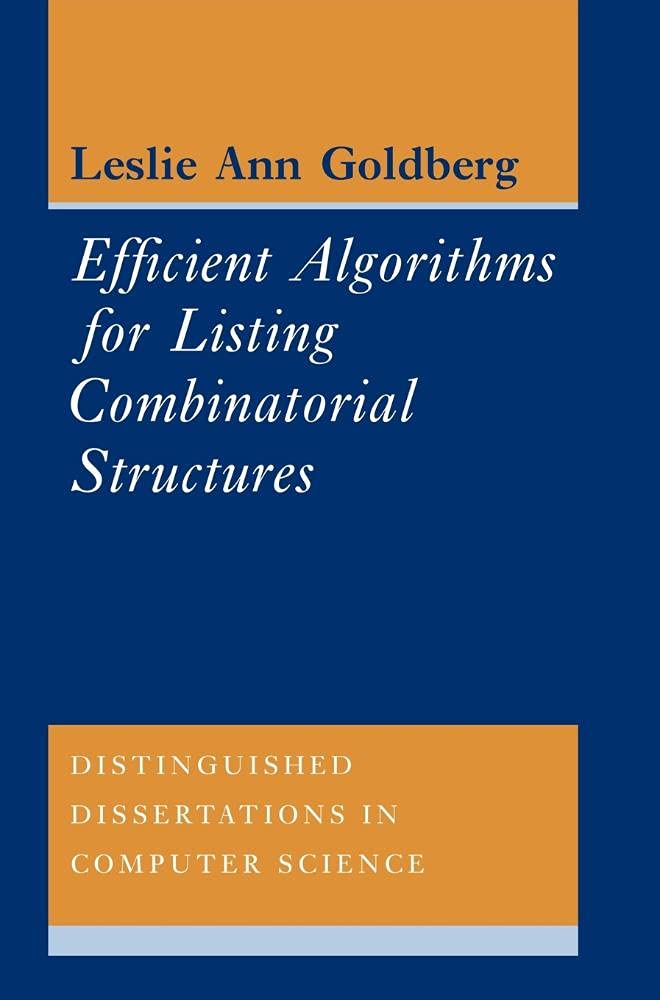
Efficient Algorithms for Listing Combinatorial Structures by Leslie Ann Goldberg – A Cambridge University Press Hardcove
Inclusive of all applicable taxes. FREE shipping on all orders.
Available Offers
- 🚚Free Delivery — Free shipping on all orders
- 💵Cash on Delivery — Pay when your order arrives
- ↩️15-Day Easy Returns — Hassle-free return policy
- 🔒Cash on Delivery — Pay safely when your order arrives
Check Delivery
Product Description
Introduction
In the ever-evolving world of theoretical computer science and discrete mathematics, few challenges are as fundamental as the efficient listing of combinatorial structures. Leslie Ann Goldberg's seminal work, Efficient Algorithms for Listing Combinatorial Structures, published by Cambridge University Press, offers a rigorous and insightful exploration of this critical domain. For students, researchers, and professionals in India who are passionate about algorithm design, graph theory, and computational complexity, this hardcover volume serves as an essential reference. It bridges the gap between abstract mathematical theory and practical algorithmic solutions, providing deep clarity on how to systematically generate members of various combinatorial families.
Book Overview
First published in 1993, this thesis-driven monograph addresses a core question: which families of combinatorial structures can be listed quickly by computer algorithms, and what general strategies make such listings possible? Goldberg's work is not merely a collection of algorithms; it is a thoughtful investigation into the boundaries of efficient enumeration. The book examines families such as unlabelled graphs, Hamiltonian graphs, graphs with cliques of specified order, and k-colourable graphs, among others. It also compares the listing problem with related computational tasks—existence, construction, random sampling, and counting—offering a holistic view of the algorithmic landscape. Notably, the text demonstrates the difficulty of evaluating Pólya's cycle polynomial, a result with far-reaching implications.
Key Highlights
- Seminal Research: A classic thesis that has influenced subsequent work in combinatorial enumeration and algorithm design.
- Broad Coverage: Explores a wide range of combinatorial families, including unlabelled graphs, Hamiltonian graphs, and k-colourable graphs.
- Comparative Analysis: Relates listing problems to existence, construction, random sampling, and counting problems, providing a unified perspective.
- Rigorous Yet Accessible: Written with clarity suitable for advanced undergraduate and graduate students in computer science and mathematics.
- Enduring Relevance: The principles and techniques discussed remain foundational for modern algorithmic research.
Inside the Book
The book is structured around the design and analysis of algorithms that list combinatorial structures efficiently. Goldberg begins by establishing the theoretical framework, defining what it means for a listing algorithm to be efficient, and introducing the complexity measures used. She then delves into specific families, presenting algorithms and proving their correctness and optimality. The discussion of Pólya's cycle polynomial is particularly notable, as it highlights the inherent difficulty of certain counting problems. Throughout the text, the author connects abstract combinatorial concepts to concrete algorithmic implementations, making the material practical for those who wish to apply these methods in their own work.
Key Topics
- Efficient listing algorithms for unlabelled graphs and their properties
- First-order one properties and their role in combinatorial enumeration
- Listing Hamiltonian graphs and graphs with cliques of specified order
- Algorithms for k-colourable graphs and related structures
- Comparison of listing, existence, construction, random sampling, and counting problems
- Difficulty of evaluating Pólya's cycle polynomial
- General methods for designing listing algorithms across families
Reader Benefits
By engaging with this book, readers will gain a deep understanding of how to approach the listing of combinatorial structures systematically. The algorithms and theoretical insights presented here can be directly applied to research in graph theory, computational complexity, and algorithm design. Indian students preparing for competitive examinations or pursuing advanced studies will find the rigorous treatment invaluable for building a strong foundation. Additionally, the comparative analysis of computational problems equips readers with a broader perspective on the relationships between different algorithmic tasks, enhancing their problem-solving toolkit.
Learning Outcomes
- Understand the fundamental challenges in listing combinatorial structures efficiently
- Analyze and design algorithms for families such as unlabelled graphs and k-colourable graphs
- Evaluate the complexity of listing problems and relate them to existence, counting, and sampling problems
- Apply general methods like backtracking, isomorphism rejection, and dynamic programming to new combinatorial families
- Recognize the significance of Pólya's cycle polynomial and its computational difficulty
- Develop a research-oriented mindset for exploring open problems in combinatorial enumeration
Who Should Read
This book is ideally suited for advanced undergraduate and graduate students in computer science, mathematics, and related disciplines. Researchers in algorithmic graph theory, computational complexity, and combinatorial enumeration will find it a valuable reference. It is also recommended for professionals in India who work on algorithm design, data structures, or theoretical computing and wish to deepen their knowledge of enumeration techniques. Educators teaching courses on algorithms or discrete mathematics can use this text to enrich their curriculum with cutting-edge research.
About the Author
Leslie Ann Goldberg is a distinguished computer scientist known for her contributions to theoretical computer science, particularly in the areas of algorithms, complexity theory, and combinatorial enumeration. Her work has been widely cited and has influenced generations of researchers. With a career spanning decades, Goldberg has held academic positions at leading institutions and has published numerous papers that advance the understanding of efficient computation. This book reflects her deep expertise and her ability to communicate complex ideas with precision and clarity.
About the Publisher
Cambridge University Press is one of the world's oldest and most prestigious academic publishers, with a history dating back to 1534. Renowned for its rigorous editorial standards and commitment to scholarly excellence, Cambridge University Press publishes works that shape academic discourse globally. This hardcover edition of Efficient Algorithms for Listing Combinatorial Structures upholds that tradition, offering readers a durable and authoritative volume that will stand the test of time.
Conclusion
Efficient Algorithms for Listing Combinatorial Structures by Leslie Ann Goldberg is more than a book—it is a gateway to a deeper understanding of algorithmic design and combinatorial theory. For Indian students and researchers who aspire to excel in computer science, this hardcover edition from Cambridge University Press is an indispensable addition to their library. Whether you are studying graph theory, preparing for advanced research, or simply fascinated by the power of algorithms, this book will challenge and inspire you. Add it to your collection today and explore the elegant world of combinatorial listing.
Quick Summary
This book, 'Efficient Algorithms for Listing Combinatorial Structures' by Leslie Ann Goldberg, is a seminal academic work originally published in 1993 by Cambridge University Press. It addresses fundamental questions in theoretical computer science: which families of combinatorial structures can be listed efficiently, what general methods exist for such listing, and how these methods apply to families like unlabelled graphs, Hamiltonian graphs, k-colourable graphs, and graphs with cliques of specified order. The book also explores first order properties and compares the listing problem with the existence problem, offering deep insights into algorithm complexity. Targeted at researchers, graduate students, and professionals in computer science and combinatorics, this hardcover volume provides a rigorous yet accessible treatment of enumeration algorithms. Readers will gain a thorough understanding of efficient listing techniques and their theoretical underpinnings. By purchasing from Bookshops.in, Indian customers receive a genuine Cambridge University Press edition with reliable delivery and competitive pricing, supporting local bookstores.
Book Highlights
Book Specifications
| ISBN-13 | 9780521450218 |
| ISBN-10 | 0521450217 |
| Publisher | Cambridge University Press |
| Language | English |
| Dimensions | 18.42 x 1.27 x 26.04 cm |
| Weight | 490 g |
| Country | India |
| Category | Software Design, Testing & Engineering › Software Architecture |
| Genre | Non-fiction |
| Original Language | English |
Frequently Asked Questions
What is 'Efficient Algorithms for Listing Combinatorial Structures' about?
Who is the author of this book?
What is the ISBN for this book?
Is this book suitable for Indian students?
What topics are covered in this book?
What is the price of this book on Bookshops.in?
Is this book available in paperback?
What language is the book in?
Who should read this book?
Does the book compare listing and existence problems?
What general methods are discussed?
How can I buy this book from Bookshops.in?
Readers Also Search For
Customers Also Bought

Programming
Algorithmische Sprache Und Programmentwicklung | by H. Partsch | F. L. Bauer | P. Pepper | Springer | by H. Partsch | F. L. Bauer | P. Pepper | Springer | by H. Partsch | F. L. Bauer | P. Pepper | Springer | by H. Partsch | F. L. Bauer | P. Pepper | Springer | by H. Partsch | F. L. Bauer | P. Pepper | Springer | by H. Partsch | F. L. Bauer | P. Pepper | Springer | by H. Partsch | F. L. Bauer | P. Pepper | Springer | by H. Partsch | F. L. Bauer | P. Pepper | Springer | by H. Partsch | F. L. Bauer
Programming
Distributed Algorithms | by Jean-Claude Bermond | Michel Raynal | Springer | by Jean-Claude Bermond | Michel Raynal | Springer | by Jean-Claude Bermond | Michel Raynal | Springer | by Jean-Claude Bermond | Michel Raynal | Springer | by Jean-Claude Bermond | Michel Raynal | Springer | by Jean-Claude Bermond | Michel Raynal | Springer | by Jean-Claude Bermond | Michel Raynal | Springer | by Jean-Claude Bermond | Michel Raynal | Springer | by Jean-Claude Bermond | Michel Raynal | Springer | by Jean

Programming
Meta-Level Control for Deductive Database Systems | by Helmut Schmidt | Springer | by Helmut Schmidt | Springer | by Helmut Schmidt | Springer | by Helmut Schmidt | Springer | by Helmut Schmidt | Springer | by Helmut Schmidt | Springer | by Helmut Schmidt | Springer | by Helmut Schmidt | Springer | by Helmut Schmidt | Springer | by Helmut Schmidt | Springer | by Helmut Schmidt | Springer | by Helmut Schmidt | Springer | by Helmut Schmidt | Springer | by Helmut Schmidt | Springer | by Helmut Schm

Programming
Java Web Services | by David A. Chappell | Tyler Jewell | O'Reilly Media | by David A. Chappell | Tyler Jewell | O'Reilly Media | by David A. Chappell | Tyler Jewell | O'Reilly Media | by David A. Chappell | Tyler Jewell | O'Reilly Media | by David A. Chappell | Tyler Jewell | O'Reilly Media | by David A. Chappell | Tyler Jewell | O'Reilly Media | by David A. Chappell | Tyler Jewell | O'Reilly Media | by David A. Chappell | Tyler Jewell | O'Reilly Media | by David A. Chappell | Tyler Jewell | O'

Programming
Database in Depth | by Chris J. Date | O'Reilly Media | by Chris J. Date | O'Reilly Media | by Chris J. Date | O'Reilly Media | by Chris J. Date | O'Reilly Media | by Chris J. Date | O'Reilly Media | by Chris J. Date | O'Reilly Media | by Chris J. Date | O'Reilly Media | by Chris J. Date | O'Reilly Media | by Chris J. Date | O'Reilly Media | by Chris J. Date | O'Reilly Media | by Chris J. Date | O'Reilly Media | by Chris J. Date | O'Reilly Media | by Chris J. Date | O'Reilly Media | by Chris J.

Programming
Integration of AI and OR Techniques in Constraint Programming for Combinatorial Optimization Problem | by Nicolas Beldiceanu | Narendra Jussien | Eric Pinson | Springer | by Nicolas Beldiceanu | Narendra Jussien | Eric Pinson | Springer | by Nicolas Beldiceanu | Narendra Jussien | Eric Pinson | Springer | by Nicolas Beldiceanu | Narendra Jussien | Eric Pinson | Springer | by Nicolas Beldiceanu | Narendra Jussien | Eric Pinson | Springer | by Nicolas Beldiceanu | Narendra Jussien | Eric Pinson |
Related Products
View All
Computers & Internet
Modern Full-Stack React Projects by Daniel Bugl

Computers & Internet
Mootools 1.2 Beginner's Guide (English, Jacob Gube)
Computers & Internet
Contemporary Methods for Speech Parameterization (Springerbriefs in Electrical and Computer Engineering / Springerbriefs in Speech Technology)

Computers & Internet
Information Technology and Lawyers | by Arno R. Lodder | Anja Oskamp | Springer | by Arno R. Lodder | Anja Oskamp | Springer | by Arno R. Lodder | Anja Oskamp | Springer | by Arno R. Lodder | Anja Oskamp | Springer | by Arno R. Lodder | Anja Oskamp | Springer | by Arno R. Lodder | Anja Oskamp | Springer | by Arno R. Lodder | Anja Oskamp | Springer | by Arno R. Lodder | Anja Oskamp | Springer | by Arno R. Lodder | Anja Oskamp | Springer | by Arno R. Lodder | Anja Oskamp | Springer | by Arno R. Lo

Computers & Internet
Digital Analysis of Remotely Sensed Imagery | by Jay Gao | McGraw-Hill Companies | by Jay Gao | McGraw-Hill Companies | by Jay Gao | McGraw-Hill Companies | by Jay Gao | McGraw-Hill Companies | by Jay Gao | McGraw-Hill Companies | by Jay Gao | McGraw-Hill Companies | by Jay Gao | McGraw-Hill Companies | by Jay Gao | McGraw-Hill Companies | by Jay Gao | McGraw-Hill Companies | by Jay Gao | McGraw-Hill Companies | by Jay Gao | McGraw-Hill Companies | by Jay Gao | McGraw-Hill Companies | by Jay Gao

Computers & Internet