
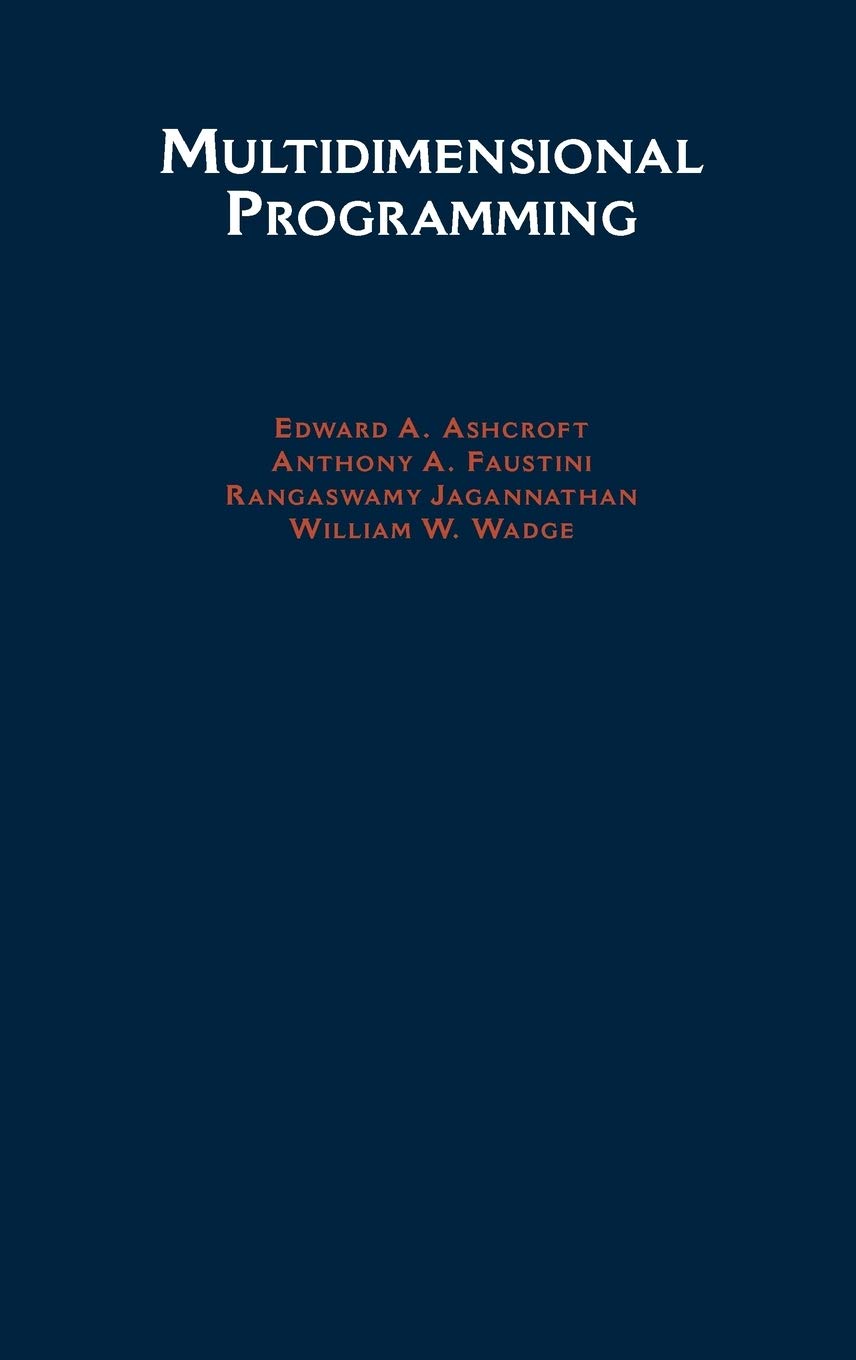
Multidimensional Programming: A Deep Dive into Lucid and Intensional Logic by Edward A. Ashcroft
Inclusive of all applicable taxes. FREE shipping on all orders.
Available Offers
- 🚚Free Delivery — Free shipping on all orders
- 💵Cash on Delivery — Pay when your order arrives
- ↩️15-Day Easy Returns — Hassle-free return policy
- 🔒Cash on Delivery — Pay safely when your order arrives
Check Delivery
Product Description
Introduction
In the ever-evolving landscape of programming languages, few works have dared to challenge the very foundations of how we think about computation. Multidimensional Programming by Edward A. Ashcroft, published by Oxford University Press, is a seminal text that introduces readers to a radically different paradigm: declarative programming through the lens of intensional logic. This hardcover edition is a must-have for serious students of computer science, researchers, and practitioners who wish to explore a language that treats time, space, and context as first-class citizens. For Indian readers and students seeking to deepen their understanding of programming theory, this book offers a rare and rigorous intellectual journey.
Book Overview
Multidimensional Programming presents the Lucid programming language in its mature form, evolved over a decade of research. Unlike conventional languages that focus on sequences of instructions, Lucid is built on the idea of indexicality — the ability to refer to values that change across multiple dimensions such as time, space, or user-defined contexts. This book is not merely a language manual; it is a comprehensive exploration of how intensional logic can transform the way we build and reason about software. Ashcroft masterfully bridges the gap between abstract mathematical semantics and practical programming, making this work both a theoretical treatise and a practical guide.
Key Highlights
- Pioneering use of intensional logic in programming language design
- Complete syntax and mathematical semantics of the Lucid language
- Formal systems for program transformation and verification
- Applications in multidimensional data processing and software systems construction
- Written by a leading computer scientist with decades of research experience
Inside the Book
The book is structured to take the reader from foundational concepts to advanced applications. Early chapters introduce the philosophical underpinnings of intensionality and explain how Lucid differs from traditional imperative and functional languages. The middle sections delve into the formal semantics using denotational methods, while later chapters demonstrate how Lucid can be used to elegantly express problems involving time-varying data, interactive systems, and parallel computations. Each chapter includes illustrative examples and exercises that reinforce the material.
Key Topics
- Intensional logic and indexicality in programming
- Lucid language syntax and operational semantics
- Mathematical foundations: denotational semantics and fixed-point theory
- Program transformation and verification using Lucid
- Multidimensional data structures and streams
- Implementation techniques for declarative languages
- Applications in real-time systems, simulation, and software engineering
Reader Benefits
Readers will gain a deep appreciation for how programming languages can be designed around logical principles rather than machine architecture. By studying Lucid, you will learn to think about computation in terms of contexts and dimensions, a skill that is increasingly valuable in fields like data science, artificial intelligence, and distributed systems. The book also sharpens your ability to reason formally about program correctness, a critical competency for any serious software professional.
Learning Outcomes
- Understand the core concepts of intensional logic and its application to programming
- Write and analyze programs in the Lucid language
- Apply formal methods for program transformation and verification
- Design multidimensional data models and algorithms
- Evaluate the implications of declarative paradigms for software construction
Who Should Read
This book is ideal for postgraduate students in computer science, especially those specializing in programming languages, formal methods, or theoretical computer science. It is also highly relevant for researchers exploring non-traditional programming models and for educators looking to introduce advanced paradigms in their curriculum. Undergraduate students with a strong background in discrete mathematics and logic will also find the material accessible and rewarding.
About the Author
Edward A. Ashcroft is a distinguished computer scientist known for his foundational contributions to programming language theory. He was a professor at the University of Waterloo and later at the University of California, Berkeley. His work on Lucid, alongside William W. Wadge, has influenced generations of researchers in declarative and multidimensional programming. Ashcroft's writing is clear, precise, and deeply insightful, making complex ideas accessible to dedicated readers.
About the Publisher
Oxford University Press is a globally respected academic publisher with a rich history of producing authoritative texts in science, technology, and humanities. This hardcover edition reflects OUP's commitment to quality, featuring durable binding and high-quality paper that will withstand years of study. For Indian readers, OUP's distribution ensures that this classic work is available through trusted booksellers like Bookshops.in.
Conclusion
Multidimensional Programming is not just a book about a language; it is a gateway to a new way of thinking about computation. For anyone serious about understanding the deeper structures of programming, this hardcover volume is an invaluable addition to your library. Whether you are a student, researcher, or professional, Ashcroft's masterful exposition will challenge your assumptions and expand your intellectual horizons. Order your copy today from Bookshops.in and embark on a journey into the multidimensional world of declarative programming.
Quick Summary
Multidimensional Programming by Edward A. Ashcroft is a definitive guide to the Lucid programming language, which is built on the principles of intensional logic. This book takes readers on a journey from the theoretical foundations of indexicality and multidimensional objects to practical implementations and applications. It is designed for advanced computer science students, researchers, and professionals who want to explore declarative programming beyond conventional paradigms. Readers will learn how Lucid implicitly expresses change and multidimensionality, offering a fresh perspective on programming language design. The book also delves into mathematical semantics, making it a rigorous academic resource. Published by Oxford University Press, this hardcover edition is a valuable addition to any library. By purchasing from Bookshops.in, Indian customers receive authentic copies with reliable service, supporting local bookstores while expanding their technical knowledge.
Book Highlights
Book Specifications
| ISBN-13 | 9780195075977 |
| ISBN-10 | 0195075978 |
| Publisher | Oxford Univ Pr on Demand |
| Language | English |
| Dimensions | 15.6 x 1.12 x 23.39 cm |
| Weight | 363 g |
| Country | USA |
| Category | Languages › C & C++ |
| Genre | Non-fiction |
| Original Language | English |
Frequently Asked Questions
What is Multidimensional Programming about?
Who is the author of this book?
Which publisher released this book?
What is the ISBN-13 for this book?
Is this book suitable for beginners?
What language is the book written in?
What is the binding type?
What is the price in INR?
Does this book cover Lucid language implementations?
What is intensional logic?
Can I use this book for a university course?
Are there practical examples in the book?
Is this book available in digital format?
Why buy from Bookshops.in?
Readers Also Search For
Customers Also Bought

Programming
Algorithmische Sprache Und Programmentwicklung | by H. Partsch | F. L. Bauer | P. Pepper | Springer | by H. Partsch | F. L. Bauer | P. Pepper | Springer | by H. Partsch | F. L. Bauer | P. Pepper | Springer | by H. Partsch | F. L. Bauer | P. Pepper | Springer | by H. Partsch | F. L. Bauer | P. Pepper | Springer | by H. Partsch | F. L. Bauer | P. Pepper | Springer | by H. Partsch | F. L. Bauer | P. Pepper | Springer | by H. Partsch | F. L. Bauer | P. Pepper | Springer | by H. Partsch | F. L. Bauer
Programming
Distributed Algorithms | by Jean-Claude Bermond | Michel Raynal | Springer | by Jean-Claude Bermond | Michel Raynal | Springer | by Jean-Claude Bermond | Michel Raynal | Springer | by Jean-Claude Bermond | Michel Raynal | Springer | by Jean-Claude Bermond | Michel Raynal | Springer | by Jean-Claude Bermond | Michel Raynal | Springer | by Jean-Claude Bermond | Michel Raynal | Springer | by Jean-Claude Bermond | Michel Raynal | Springer | by Jean-Claude Bermond | Michel Raynal | Springer | by Jean

Programming
Meta-Level Control for Deductive Database Systems | by Helmut Schmidt | Springer | by Helmut Schmidt | Springer | by Helmut Schmidt | Springer | by Helmut Schmidt | Springer | by Helmut Schmidt | Springer | by Helmut Schmidt | Springer | by Helmut Schmidt | Springer | by Helmut Schmidt | Springer | by Helmut Schmidt | Springer | by Helmut Schmidt | Springer | by Helmut Schmidt | Springer | by Helmut Schmidt | Springer | by Helmut Schmidt | Springer | by Helmut Schmidt | Springer | by Helmut Schm
Programming
Java Web Services | by David A. Chappell | Tyler Jewell | O'Reilly Media | by David A. Chappell | Tyler Jewell | O'Reilly Media | by David A. Chappell | Tyler Jewell | O'Reilly Media | by David A. Chappell | Tyler Jewell | O'Reilly Media | by David A. Chappell | Tyler Jewell | O'Reilly Media | by David A. Chappell | Tyler Jewell | O'Reilly Media | by David A. Chappell | Tyler Jewell | O'Reilly Media | by David A. Chappell | Tyler Jewell | O'Reilly Media | by David A. Chappell | Tyler Jewell | O'
Programming
Database in Depth | by Chris J. Date | O'Reilly Media | by Chris J. Date | O'Reilly Media | by Chris J. Date | O'Reilly Media | by Chris J. Date | O'Reilly Media | by Chris J. Date | O'Reilly Media | by Chris J. Date | O'Reilly Media | by Chris J. Date | O'Reilly Media | by Chris J. Date | O'Reilly Media | by Chris J. Date | O'Reilly Media | by Chris J. Date | O'Reilly Media | by Chris J. Date | O'Reilly Media | by Chris J. Date | O'Reilly Media | by Chris J. Date | O'Reilly Media | by Chris J.

Programming
Integration of AI and OR Techniques in Constraint Programming for Combinatorial Optimization Problem | by Nicolas Beldiceanu | Narendra Jussien | Eric Pinson | Springer | by Nicolas Beldiceanu | Narendra Jussien | Eric Pinson | Springer | by Nicolas Beldiceanu | Narendra Jussien | Eric Pinson | Springer | by Nicolas Beldiceanu | Narendra Jussien | Eric Pinson | Springer | by Nicolas Beldiceanu | Narendra Jussien | Eric Pinson | Springer | by Nicolas Beldiceanu | Narendra Jussien | Eric Pinson |
Related Products
View All
Computers & Internet
Modern Full-Stack React Projects by Daniel Bugl
Computers & Internet
Mootools 1.2 Beginner's Guide (English, Jacob Gube)
Computers & Internet
Contemporary Methods for Speech Parameterization (Springerbriefs in Electrical and Computer Engineering / Springerbriefs in Speech Technology)

Computers & Internet
Information Technology and Lawyers | by Arno R. Lodder | Anja Oskamp | Springer | by Arno R. Lodder | Anja Oskamp | Springer | by Arno R. Lodder | Anja Oskamp | Springer | by Arno R. Lodder | Anja Oskamp | Springer | by Arno R. Lodder | Anja Oskamp | Springer | by Arno R. Lodder | Anja Oskamp | Springer | by Arno R. Lodder | Anja Oskamp | Springer | by Arno R. Lodder | Anja Oskamp | Springer | by Arno R. Lodder | Anja Oskamp | Springer | by Arno R. Lodder | Anja Oskamp | Springer | by Arno R. Lo

Computers & Internet
Digital Analysis of Remotely Sensed Imagery | by Jay Gao | McGraw-Hill Companies | by Jay Gao | McGraw-Hill Companies | by Jay Gao | McGraw-Hill Companies | by Jay Gao | McGraw-Hill Companies | by Jay Gao | McGraw-Hill Companies | by Jay Gao | McGraw-Hill Companies | by Jay Gao | McGraw-Hill Companies | by Jay Gao | McGraw-Hill Companies | by Jay Gao | McGraw-Hill Companies | by Jay Gao | McGraw-Hill Companies | by Jay Gao | McGraw-Hill Companies | by Jay Gao | McGraw-Hill Companies | by Jay Gao

Computers & Internet