
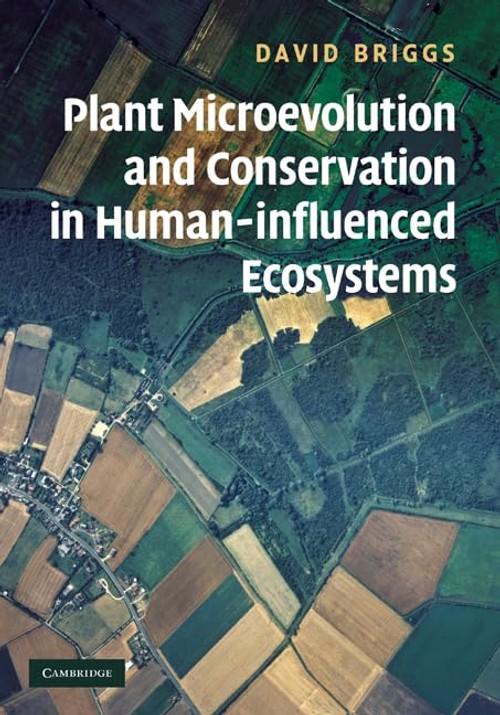
Plant Microevolution and Conservation in Human-influenced Ecosystems by David Briggs – An In-Depth Exploration of Darwin
Inclusive of all applicable taxes. FREE shipping on all orders.
Available Offers
- 🚚Free Delivery — Free shipping on all orders
- 💵Cash on Delivery — Pay when your order arrives
- ↩️15-Day Easy Returns — Hassle-free return policy
- 🔒Cash on Delivery — Pay safely when your order arrives
Check Delivery
Product Description
Introduction
In an era where human activity is reshaping every corner of our planet, understanding how plant species adapt, survive, or vanish has never been more critical. David Briggs’ Plant Microevolution and Conservation in Human-influenced Ecosystems offers a compelling, science-backed exploration of the subtle evolutionary changes that plants undergo in response to human pressures. Published by Cambridge University Press, this hardcover volume is an essential resource for Indian students, researchers, and conservationists who seek to grasp the intricate dance between evolution and conservation in our rapidly changing world.
Book Overview
This book delves deep into the micro-evolutionary processes that shape plant populations in ecosystems heavily altered by human activities. From agricultural fields and urban landscapes to fragmented forests and restoration sites, Briggs examines how plants—whether wild, weedy, invasive, or endangered—respond to new selection pressures. Drawing on Darwinian principles and global case studies, the author argues that evolution is an ongoing, observable phenomenon. The book also tackles pressing questions: Can we conserve endangered species through active management? Is it possible to recreate lost ecosystems? With a balanced mix of theory and real-world examples, this text bridges the gap between evolutionary biology and conservation science.
Key Highlights
- Darwinian insights applied to modern conservation: Explores natural selection, speciation, and the vulnerability of rare species in human-dominated landscapes.
- Global case studies: Includes examples from India, Australia, Europe, and the Americas, making it relevant for Indian readers.
- Focus on micro-evolution: Examines small-scale genetic changes in plant populations due to pollution, climate change, habitat fragmentation, and invasive species.
- Practical conservation strategies: Discusses management, restoration, and the ethics of recreating damaged ecosystems.
- Rigorous yet accessible: Written for both students and professionals, with clear explanations of complex concepts.
Inside the Book
The book is organized into thematic chapters that build a comprehensive understanding. Early sections introduce the fundamentals of micro-evolution and the history of Darwinian thought. Subsequent chapters dive into specific human influences: agriculture, urbanization, climate change, and biological invasions. Each chapter weaves together empirical data, theoretical models, and conservation implications. Briggs also dedicates space to the challenges of conserving rare and threatened species, offering insights into genetic rescue, habitat corridors, and assisted migration. The final chapters reflect on the philosophical and practical limits of restoration ecology, asking whether we can truly ‘recreate’ nature.
Key Topics
- Natural selection in anthropogenic environments
- Genetic drift and gene flow in fragmented populations
- Evolution of weedy and invasive plant species
- Climate change adaptation and micro-evolutionary responses
- Conservation genetics and management of endangered plants
- Restoration ecology and the concept of ‘novel ecosystems’
- Darwin’s legacy in modern conservation biology
Reader Benefits
Indian students and researchers will find this book particularly valuable as it connects global evolutionary theory to local conservation challenges. Whether you are studying the impact of urban sprawl on native flora in Bengaluru, the spread of invasive Lantana in the Western Ghats, or the genetic health of rare Himalayan herbs, Briggs provides the conceptual toolkit to analyze these issues. The book encourages critical thinking about human roles in shaping biodiversity and offers evidence-based approaches to mitigate negative impacts. By understanding micro-evolution, readers can better predict how plant communities will change and what interventions might work.
Learning Outcomes
- Understand how human activities create new selective pressures on plant populations.
- Analyze micro-evolutionary processes such as adaptation, gene flow, and genetic drift in real-world contexts.
- Evaluate conservation strategies using evolutionary principles.
- Critically assess the feasibility of restoring damaged ecosystems.
- Apply Darwinian concepts to contemporary environmental problems in India and beyond.
Who Should Read
This book is ideal for postgraduate students and researchers in botany, ecology, evolution, and conservation biology. It is also highly relevant for wildlife managers, environmental consultants, and policy makers involved in biodiversity conservation. Undergraduate students with a strong foundation in biology will find it accessible and enriching. Indian readers engaged in fieldwork or conservation projects will appreciate the practical insights and global perspective.
About the Author
David Briggs is a distinguished botanist and evolutionary biologist with decades of experience in plant population biology and conservation. He has published extensively on the genetics of wild and cultivated plants, and his work has influenced conservation practices worldwide. Briggs’ ability to synthesize complex evolutionary theory with on-the-ground conservation challenges makes him a trusted voice in the field.
About the Publisher
Cambridge University Press is one of the world’s oldest and most respected academic publishers. Known for rigorous peer review and high-quality scholarship, Cambridge books are a staple in university libraries and research institutions across India. This hardcover edition is built to last, with clear typesetting and durable binding—perfect for years of reference in the classroom or field.
Conclusion
Plant Microevolution and Conservation in Human-influenced Ecosystems is more than a textbook—it is a call to recognize that evolution is happening around us, every day. David Briggs offers a thoughtful, evidence-based guide for anyone committed to preserving plant diversity in a human-dominated world. For Indian students and conservationists, this book provides both the scientific foundation and the practical wisdom needed to tackle the environmental challenges of our time.
Quick Summary
Plant Microevolution and Conservation in Human-influenced Ecosystems by David Briggs is a seminal work that explores how human activities are driving evolutionary changes in plant populations worldwide. The book delves into the microevolutionary processes—such as natural selection, genetic drift, and gene flow—that affect wild, weedy, invasive, feral, and endangered species. Using diverse case studies from around the globe, Briggs demonstrates that Darwinian evolution is ongoing even in heavily modified landscapes. He critically examines the possibilities and limitations of conserving endangered species and restoring damaged ecosystems, questioning how precisely we can recreate original plant communities. This book is ideal for advanced undergraduate and postgraduate students, researchers, and professionals in botany, ecology, conservation biology, and environmental science. Readers will gain a nuanced understanding of how human influence shapes biodiversity and learn practical approaches to management and restoration. By purchasing from Bookshops.in, Indian readers receive a high-quality hardcover edition with fast delivery and excellent customer service, supporting their academic and professional growth.
Book Highlights
Book Specifications
| ISBN-13 | 9780521818353 |
| ISBN-10 | 0521818354 |
| Publisher | Cambridge University Press |
| Language | English |
| Dimensions | 17.78 x 3.18 x 24.77 cm |
| Weight | 1 kg 350 g |
| Country | India |
| Category | Basic Sciences › Pharmacology |
| Genre | Non-fiction |
| Original Language | English |
Frequently Asked Questions
What is the main focus of this book?
Who is the author David Briggs?
Is this book suitable for Indian students?
What level of knowledge is required?
Does the book cover Darwinian evolution?
Are there practical conservation examples?
Is the book only about plants?
Can this book help with conservation projects in India?
Does the book discuss genetic diversity?
Is this book used in university courses?
What makes this book unique?
Does the book address climate change?
Where can I buy this book in India?
Readers Also Search For
Customers Also Bought

Anatomy
Ultrastructure of the Digestive Tract: 4 (Electron Microscopy in Biology and Medicine)

Anatomy
Ultrastructure of the Connective Tissue Matrix: 3 (Electron Microscopy in Biology and Medicine)

Anatomy
Reproductive Genetics (Royal College of Obstetricians and Gynaecologists Study Group)

Anatomy
Human Gross Anatomy: An Outline Text by Robert J. Leonard – Medical Anatomy

Pharmacology
Mathematical Modeling and Simulation in Enteric Neurobiology

Anatomy
Nature’s Patterns and the Fractional Calculus: 2 (Fractional Calculus in Applied Sciences and Engineering, 2)
Related Products
View All
Pharmacology
A Handbook of Artificial Intelligence in Drug Delivery (English, Anil K. Philip)

Pharmacology
Electrochemotherapy, Electrogenetherapy, and Transdermal Drug Delivery by Mark J. Jaroszeski – Biome

Pharmacology
A Guide to the Extrapyramidal Side-Effects of Antipsychotic Drugs by D. G. Cunningham Owens

Pharmacology
Progress in Heterocyclic Chemistry: A Critical Review of the 2000 Literature by G. W. Gribble

Pharmacology
Handbook of Nutraceuticals, Ingredients, Formulations, and Applications (English, Yashwant Vishnupant Pathak)
Pharmacology