
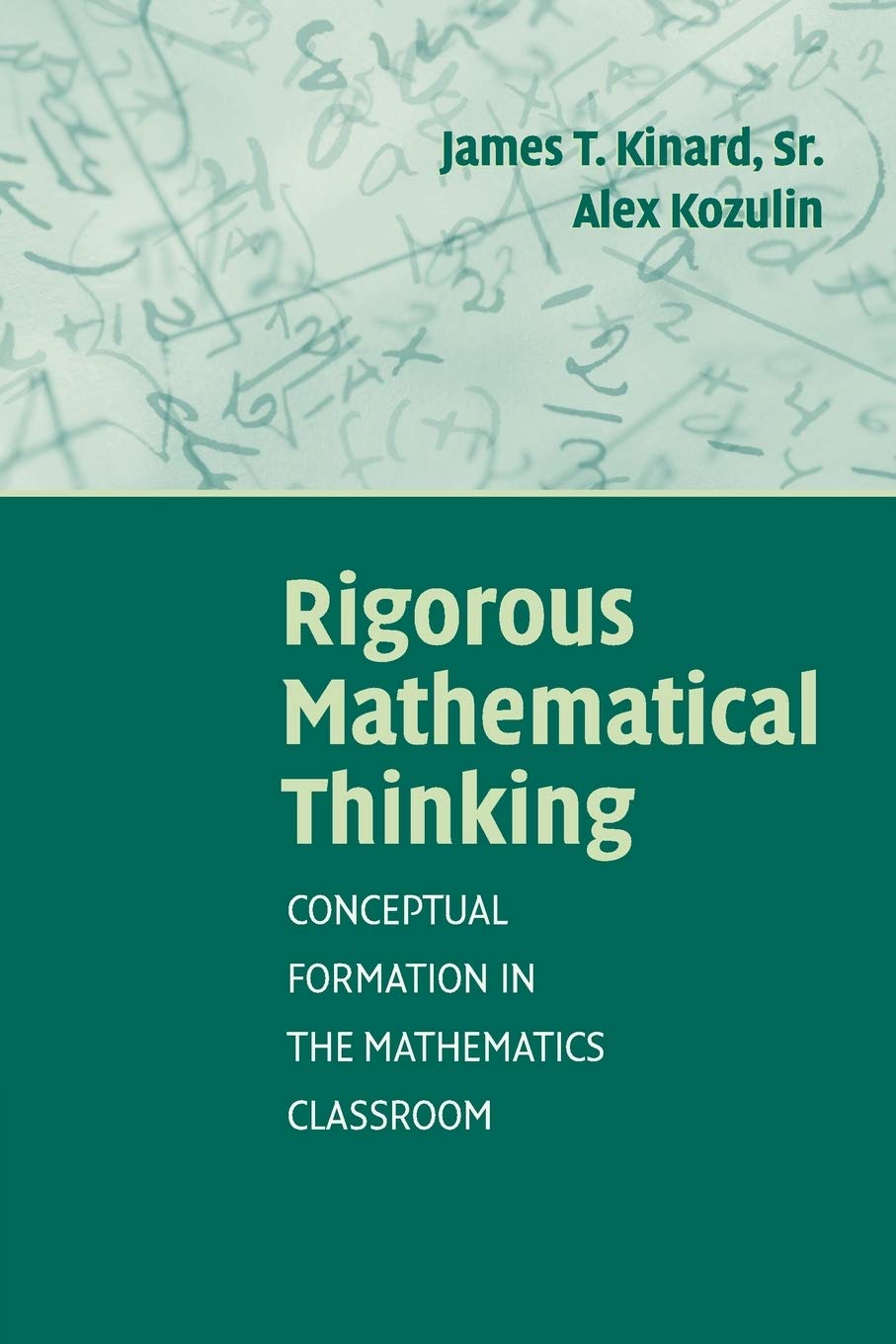
Rigorous Mathematical Thinking: A Cognitive Development Approach for Students and Educators by James T. Kinard
Inclusive of all applicable taxes. FREE shipping on all orders.
Available Offers
- 🚚Free Delivery — Free shipping on all orders
- 💵Cash on Delivery — Pay when your order arrives
- ↩️15-Day Easy Returns — Hassle-free return policy
- 🔒Cash on Delivery — Pay safely when your order arrives
Check Delivery
Product Description
Introduction
In the landscape of mathematics education, few books challenge conventional wisdom as boldly as Rigorous Mathematical Thinking by James T. Kinard. Published by Cambridge University Press, this hardbound volume offers a transformative approach to teaching mathematics, especially for students who have been historically underserved by traditional methods. For Indian educators, parents, and students grappling with the pressures of competitive exams and conceptual learning, this book provides a refreshing, research-backed pathway to mathematical mastery. It is not about memorising formulas or rote problem-solving; it is about building the cognitive architecture that makes rigorous thinking possible for every learner.
Book Overview
Rigorous Mathematical Thinking (RMT) is a groundbreaking model that synthesises two powerful psychological theories: Lev Vygotsky's concept of psychological tools and Reuven Feuerstein's mediated learning experience. Kinard demonstrates that mathematical ability is not a fixed trait determined by nature or socioeconomic background. Instead, it is a set of cognitive functions that can be actively constructed and nurtured in the classroom. The book moves from general cognitive tools—essential for all problem-solving—to mathematically specific tools that enable students to form deep conceptual understanding. The RMT model has been successfully applied in urban classrooms, proving that even the most challenging mathematics education standards can be met when students are taught how to think, not just what to think.
Key Highlights
- Dual Theoretical Foundation: Integrates Vygotsky's psychological tools with Feuerstein's mediated learning to create a robust pedagogical framework.
- Focus on Cognitive Construction: Argues that cognitive functions do not mature naturally but must be actively built through targeted educational interventions.
- Proven in Diverse Classrooms: Demonstrates success with socially disadvantaged and culturally different students, making it highly relevant for India's varied educational landscape.
- Step-by-Step Progression: Begins with foundational cognitive tools and advances to mathematical conceptual formation, ensuring a logical learning curve.
- Practical Application: Offers concrete methods for teachers to mediate learning and foster rigorous thinking in real classroom settings.
Inside the Book
The book is structured to guide readers from theory to practice. Early chapters explore the nature of cognitive tools—such as comparison, classification, and logical reasoning—that underpin all mathematical activity. Later chapters delve into mathematically specific tools like quantitative reasoning, spatial orientation, and systematic search. Kinard provides detailed examples of how teachers can use mediated learning experiences to help students internalise these tools. The final sections present case studies from urban schools, illustrating how RMT can transform mathematics instruction and student outcomes. Every chapter is packed with actionable insights, making it a manual for change rather than just a theoretical treatise.
Key Topics Covered
- Cognitive Functions and Mathematical Thinking: Understanding the mental processes that enable rigorous mathematics.
- Mediated Learning Experience: How teachers can act as mediators to bridge the gap between a student's current ability and potential.
- Psychological Tools for Problem Solving: Using language, symbols, and mental models to enhance mathematical reasoning.
- Conceptual Formation in Mathematics: Moving beyond procedural fluency to deep understanding of mathematical ideas.
- Classroom Implementation of RMT: Practical strategies for applying the model across different grade levels and student populations.
Reader Benefits
- For Teachers: Gain a powerful framework to reach students who struggle with mathematics, especially those from disadvantaged backgrounds.
- For Parents: Understand how to support your child's mathematical development at home by focusing on cognitive growth rather than just answers.
- For Students: Learn to approach mathematics as a thinking discipline, building confidence and competence that lasts a lifetime.
- For Teacher Trainers: Access a validated model that can be incorporated into curriculum design and professional development programs.
- For Researchers: Explore a rich synthesis of theory and practice that opens new avenues for inquiry in mathematics education.
Learning Outcomes
By engaging with Rigorous Mathematical Thinking, readers will be able to: identify and cultivate the cognitive tools essential for mathematical reasoning; design mediated learning experiences that actively construct students' thinking abilities; apply the RMT model to help students achieve high standards in mathematics; shift from a transmission-based teaching approach to one that fosters genuine conceptual understanding; and recognise the potential in every student, regardless of social or cultural background, to excel in rigorous mathematics.
Who Should Read This Book
This book is indispensable for mathematics teachers at the primary and secondary levels, especially those working in government schools, low-income private schools, or any setting with diverse student populations. It is equally valuable for teacher educators, curriculum developers, and educational policymakers who want to implement evidence-based reforms. Parents who are deeply involved in their children's academic growth will also find the cognitive principles highly applicable. Undergraduate and postgraduate students of education or psychology will benefit from the rigorous theoretical grounding. Finally, anyone passionate about educational equity and the power of mathematics to transform lives should add this volume to their library.
About the Author
James T. Kinard is a distinguished scholar and practitioner in the field of cognitive education and mathematics learning. With decades of experience working with diverse student populations, he has developed and refined the Rigorous Mathematical Thinking model through extensive classroom research. His work is deeply influenced by the cultural-historical school of psychology, and he has collaborated with leading researchers to bring mediated learning into mainstream mathematics education. Kinard's writing reflects a rare combination of theoretical depth and practical wisdom, making complex ideas accessible to educators at all levels.
About the Publisher
Cambridge University Press is one of the world's oldest and most respected academic publishers, with a history dating back to 1534. Known for its rigorous editorial standards and commitment to advancing knowledge, Cambridge University Press publishes works that shape education and research globally. This book is part of their distinguished catalogue in education and cognitive science, ensuring that readers receive content of the highest scholarly integrity. For Indian readers, a Cambridge University Press publication represents a guarantee of quality, accuracy, and relevance to global educational discourse.
Conclusion
Rigorous Mathematical Thinking is more than a book—it is a movement towards equitable, effective mathematics education. James T. Kinard offers a clear, actionable path to help every student become a rigorous mathematical thinker, regardless of their starting point. For Indian educators and parents seeking to break the cycle of math anxiety and superficial learning, this hardcover volume is a vital resource. It challenges us to rethink what is possible in the classroom and provides the tools to make that possibility a reality. Add it to your collection today and take the first step towards transforming mathematical minds.
Quick Summary
Rigorous Mathematical Thinking by James T. Kinard is a transformative educational resource that offers a cognitive framework for developing deep mathematical understanding. Based on the pioneering theories of Vygotsky (psychological tools) and Feuerstein (mediated learning experience), the book presents the Rigorous Mathematical Thinking (RMT) model. This model emphasizes that cognitive functions are not naturally maturational but must be actively constructed through teaching. It starts with general cognitive tools essential for all problem solving and then moves to mathematically specific tools and methods. The approach is particularly effective for socially disadvantaged and culturally different students, making it highly relevant for India's diverse classrooms. Readers will learn how to foster higher-order thinking, enhance problem-solving skills, and bridge learning gaps. Published by Cambridge University Press, this hardcover is a must-have for educators, researchers, and anyone passionate about math education. Buy it at Bookshops.in for ₹2018 and experience a rigorous, research-backed path to mathematical excellence.
Book Highlights
Book Specifications
| ISBN-13 | 9780521700269 |
| ISBN-10 | 0521700264 |
| Publisher | Cambridge University Press |
| Language | English |
| Dimensions | 15.24 x 1.37 x 22.86 cm |
| Weight | 360 g |
| Country | India |
| Category | Science & Mathematics › Mathematics |
| Genre | Non-fiction |
| Original Language | English |
Frequently Asked Questions
What is Rigorous Mathematical Thinking about?
Who is the author of this book?
Which publisher released this book?
Is this book suitable for Indian students?
What is the RMT model?
Does this book include practical classroom strategies?
What age group is this book for?
Is the book available in hardcover?
What is the price of this book?
Does this book require prior knowledge of Vygotsky?
Can this book help students struggling with math?
Is the book based on research?
What language is the book in?
Where can I buy this book in India?
Readers Also Search For
Customers Also Bought
Mathematics
Stereotype Spaces and Algebras: 73 (De Gruyter Expositions in Mathematics, 73)
Mathematics
Semigroups in Algebra, Geometry and Analysis: 20 (De Gruyter Expositions in Mathematics, 20)
Mathematics
Geometry from the Pacific Rim: Proceedings of the Pacific Rim Geometry Conference held at National University of Singapore, Republic of Singapore, ... 1994 (De Gruyter Proceedings in Mathematics)
Mathematics
First International Tainan-Moscow Algebra Workshop: Proceedings of the International Conference held at National Cheng Kung University Tainan, Taiwan, ... 1994 (De Gruyter Proceedings in Mathematics)
Mathematics
Differential Geometry - Proceedings of the VIII International Colloquium (English, Jesus A. Alvarez Lopez | Eduardo Garcia-Rio)
Mathematics
Mathematical Theory of Optimal Processes (Classics of Soviet Mathematics)
Related Products
View AllMathematics
Mathematical Theory of Optimal Processes (Classics of Soviet Mathematics)
Mathematics
Stereotype Spaces and Algebras: 73 (De Gruyter Expositions in Mathematics, 73)
Mathematics
Semigroups in Algebra, Geometry and Analysis: 20 (De Gruyter Expositions in Mathematics, 20)
Mathematics
Geometry from the Pacific Rim: Proceedings of the Pacific Rim Geometry Conference held at National University of Singapore, Republic of Singapore, ... 1994 (De Gruyter Proceedings in Mathematics)
Mathematics
First International Tainan-Moscow Algebra Workshop: Proceedings of the International Conference held at National Cheng Kung University Tainan, Taiwan, ... 1994 (De Gruyter Proceedings in Mathematics)
Mathematics