
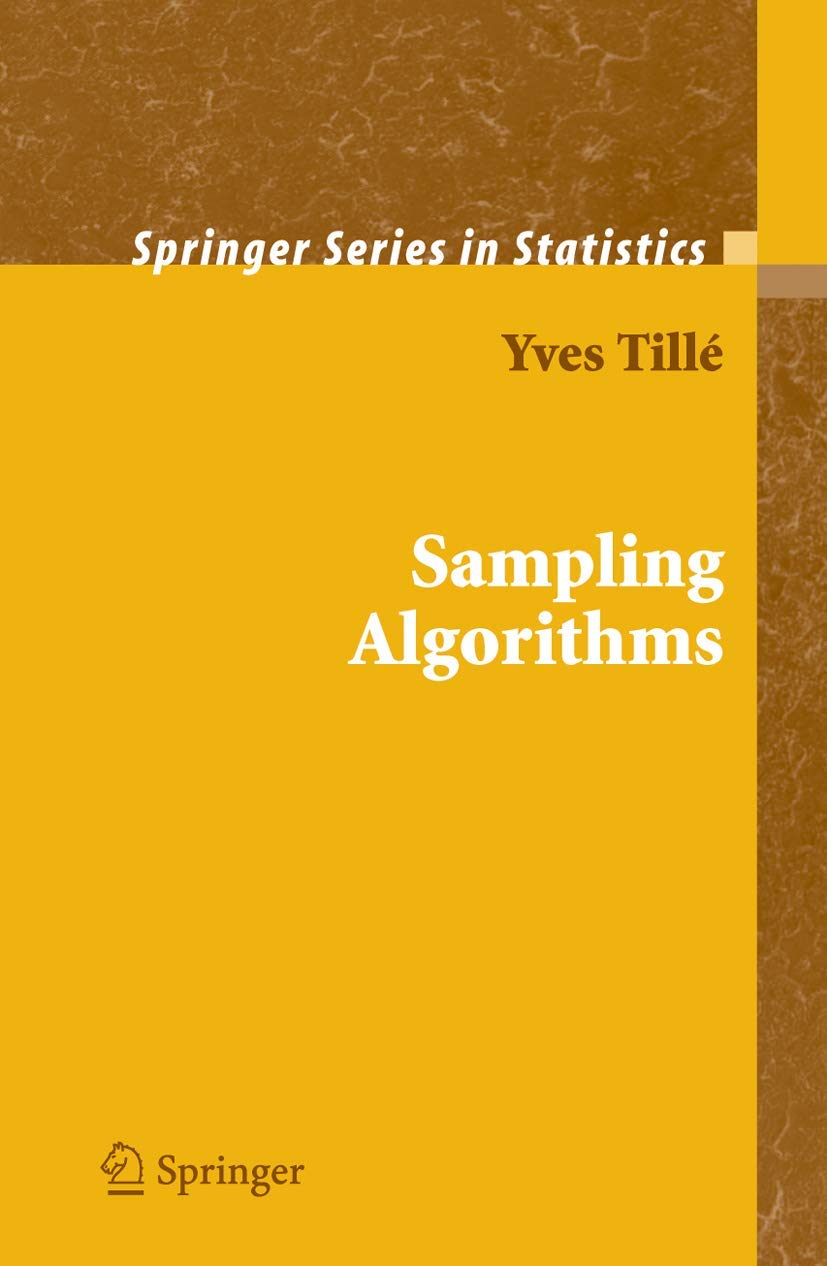
Sampling Algorithms: A Rigorous Guide to Survey Sampling Methods by Yves Tillé – Essential for Statisticians and Researc
Inclusive of all applicable taxes. FREE shipping on all orders.
Available Offers
- 🚚Free Delivery — Free shipping on all orders
- 💵Cash on Delivery — Pay when your order arrives
- ↩️15-Day Easy Returns — Hassle-free return policy
- 🔒Cash on Delivery — Pay safely when your order arrives
Check Delivery
Product Description
Introduction
In the ever-evolving field of statistics and data science, the art and science of sampling remain foundational to drawing meaningful conclusions from data. For researchers, data analysts, and statisticians, mastering sampling techniques is not just an academic exercise—it is a practical necessity. Sampling Algorithms by Yves Tillé, published by Springer, is a definitive reference that bridges theoretical rigor with algorithmic implementation. This hardcover edition is an essential addition to the library of any serious statistician, offering a comprehensive guide to forty-six distinct sampling methods. Whether you are designing surveys, conducting research, or working with big data, this book equips you with the tools to select samples with precision and confidence.
Book Overview
Sampling Algorithms is a meticulously crafted volume that presents an up-to-date inventory of modern sampling methods. Unlike introductory texts that skim the surface, this book dives deep into the algorithmic underpinnings of each technique. Yves Tillé, a renowned expert in survey sampling, provides a unified theoretical framework that ties together diverse methods, from simple random sampling to complex adaptive designs. The book is structured to allow readers to implement the algorithms directly, making it both a theoretical treatise and a practical manual. With a focus on clarity and rigor, it is designed for experienced statisticians who already have a solid grounding in survey sampling theory and are looking to expand their methodological toolkit.
Key Highlights
- Comprehensive Coverage: Explains 46 sampling methods, from classic techniques like stratified sampling to advanced methods such as balanced sampling and spatial sampling.
- Algorithmic Focus: Each method is described with precise algorithms, enabling direct implementation in statistical software or custom code.
- Unified Framework: Presents all methods within a coherent theoretical structure, making it easier to compare and contrast approaches.
- Rigorous Yet Accessible: Maintains mathematical rigor without sacrificing readability, ideal for practitioners who need both depth and usability.
- Practical Applications: Includes examples and discussions that highlight real-world use cases in survey design, official statistics, and data science.
Inside the Book
The book is organized into logical sections that guide the reader from foundational concepts to advanced topics. The opening chapters establish the theoretical groundwork, covering probability sampling, inclusion probabilities, and estimation theory. Subsequent chapters delve into specific algorithm families: simple random sampling, systematic sampling, stratified sampling, cluster sampling, and multistage designs. The latter half of the book explores more specialized methods, including balanced sampling, sampling with unequal probabilities, and spatial sampling. Each chapter concludes with algorithmic descriptions that are self-contained, allowing readers to code the methods in languages like R, Python, or SAS. The author also addresses practical issues such as variance estimation, non-response, and sample coordination.
Key Topics
- Simple random sampling and systematic sampling algorithms
- Stratified sampling with optimal allocation
- Cluster sampling and multistage designs
- Sampling with unequal probabilities (PPS sampling)
- Balanced sampling and the cube method
- Spatial sampling and environmental surveys
- Adaptive and sequential sampling methods
- Variance estimation techniques for complex designs
- Sample coordination and rotation panels
- Handling non-response and missing data
Reader Benefits
By investing in Sampling Algorithms, readers gain a powerful reference that saves countless hours of searching for method descriptions and code. The book’s algorithmic approach means you can immediately apply the techniques to your own data. You will develop a deeper understanding of how different sampling methods affect inference, enabling you to make informed decisions about study design. The unified theoretical framework also helps you identify connections between seemingly disparate methods, fostering a more intuitive grasp of sampling theory. For Indian statisticians working with complex survey data—such as those in government agencies, market research firms, or academic institutions—this book provides the rigor needed to produce reliable, publishable results.
Learning Outcomes
- Master the algorithmic implementation of 46 sampling methods from first principles.
- Understand the theoretical properties of each method, including unbiasedness, variance, and efficiency.
- Design efficient sampling strategies tailored to specific research questions and resource constraints.
- Evaluate and compare sampling methods using criteria such as cost, precision, and practicality.
- Implement sampling algorithms in statistical software for real-world data analysis.
- Critically assess the limitations and assumptions underlying each method.
Who Should Read
This book is primarily aimed at experienced statisticians, survey methodologists, and data scientists who are familiar with the basics of survey sampling. It is ideal for professionals working in official statistics, market research, public health, epidemiology, agriculture, and environmental science. Graduate students in statistics or biostatistics who have completed a course in survey sampling will also find it invaluable as a reference for advanced projects and research. Researchers in fields that rely on sample surveys—such as economics, sociology, and political science—will benefit from the algorithmic clarity that bridges theory and practice. If you are a practitioner who needs to move beyond textbook examples and implement robust sampling designs, this book is for you.
About the Author
Yves Tillé is a professor of statistics at the University of Neuchâtel in Switzerland, where he leads the Survey Sampling and Data Analysis research group. He is a leading authority on sampling theory and has published extensively on balanced sampling, spatial sampling, and algorithmic methods. His work has been influential in both academic circles and applied fields such as official statistics. Professor Tillé is also the author of several other books on sampling and is known for his clear, rigorous exposition of complex topics. His expertise ensures that Sampling Algorithms is both authoritative and accessible to the intended audience.
About the Publisher
Springer is one of the world's most respected academic publishers, known for its high-quality scientific, technical, and medical books. With a legacy spanning over 180 years, Springer has been at the forefront of disseminating cutting-edge research in mathematics, statistics, computer science, and engineering. The Springer series in statistics, to which this book belongs, is a trusted resource for researchers and professionals worldwide. Indian readers can rely on Springer’s editorial standards for accuracy, clarity, and relevance.
Conclusion
Sampling Algorithms is not just a book—it is a toolkit for the modern statistician. In a world where data is abundant but reliable inference requires careful design, this volume stands out as a comprehensive, practical, and theoretically sound guide. Yves Tillé has distilled decades of research into a single, coherent resource that will serve you for years to come. Whether you are designing a national survey, analyzing environmental data, or teaching advanced sampling techniques, this hardcover edition from Bookshops.in is an investment in precision and knowledge. Add it to your collection today and elevate your sampling practice to the next level.
Quick Summary
Sampling Algorithms by Yves Tillé is a definitive reference for statisticians and survey researchers who need a deep understanding of sample selection methods. The book systematically presents 46 sampling algorithms, covering both classic techniques like systematic and stratified sampling and advanced methods such as balanced sampling and unequal probability sampling. Each algorithm is described with rigorous mathematical detail, enabling direct implementation in statistical software. This book is intended for experienced practitioners who are already familiar with survey sampling theory and want to expand their toolkit with modern, efficient algorithms. Readers will learn how to design samples that minimize error and bias, whether for official statistics, market research, or academic studies. By purchasing from Bookshops.in, Indian customers get a genuine Springer hardcover delivered quickly across the country, with reliable customer service and competitive pricing.
Book Highlights
Book Specifications
| ISBN-13 | 9780387308142 |
| ISBN-10 | 0387308148 |
| Publisher | Springer |
| Language | English |
| Dimensions | 15.88 x 1.27 x 23.5 cm |
| Weight | 215 g |
| Category | Mathematics › Statistics |
| Genre | Non-fiction |
| Original Language | English |
Frequently Asked Questions
What is Sampling Algorithms about?
Who is the author of Sampling Algorithms?
Who should read this book?
What sampling methods are covered?
Is this book suitable for beginners?
How many algorithms are described?
Can I implement the algorithms directly?
What is the ISBN-13?
Is this book available in hardcover?
What language is the book in?
Where can I buy this book in India?
Does this book include digital resources?
What is the price of Sampling Algorithms?
Readers Also Search For
Customers Also Bought
Mathematics
Stereotype Spaces and Algebras: 73 (De Gruyter Expositions in Mathematics, 73)
Mathematics
Semigroups in Algebra, Geometry and Analysis: 20 (De Gruyter Expositions in Mathematics, 20)

Mathematics
Geometry from the Pacific Rim: Proceedings of the Pacific Rim Geometry Conference held at National University of Singapore, Republic of Singapore, ... 1994 (De Gruyter Proceedings in Mathematics)

Mathematics
First International Tainan-Moscow Algebra Workshop: Proceedings of the International Conference held at National Cheng Kung University Tainan, Taiwan, ... 1994 (De Gruyter Proceedings in Mathematics)

Mathematics
Differential Geometry - Proceedings of the VIII International Colloquium (English, Jesus A. Alvarez Lopez | Eduardo Garcia-Rio)
Mathematics
Mathematical Theory of Optimal Processes (Classics of Soviet Mathematics)
Related Products
View All
Statistics
Asymptotics in Statistics and Probability: Papers in Honor of George Gregory Roussas

Statistics
Inequalities in Analysis and Probability: 3rd Edition
Statistics
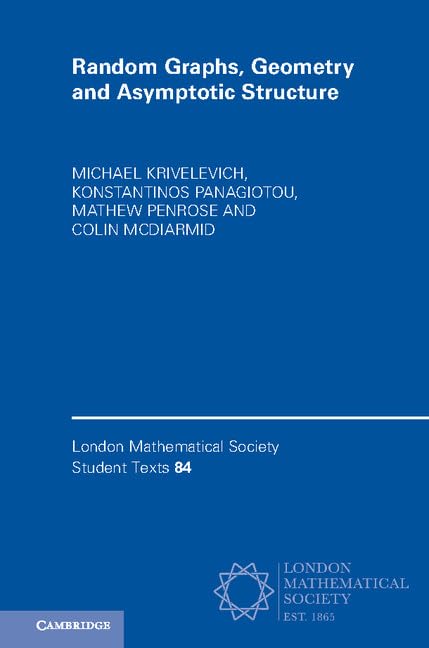
Random Graphs, Geometry and Asymptotic Structure
Statistics
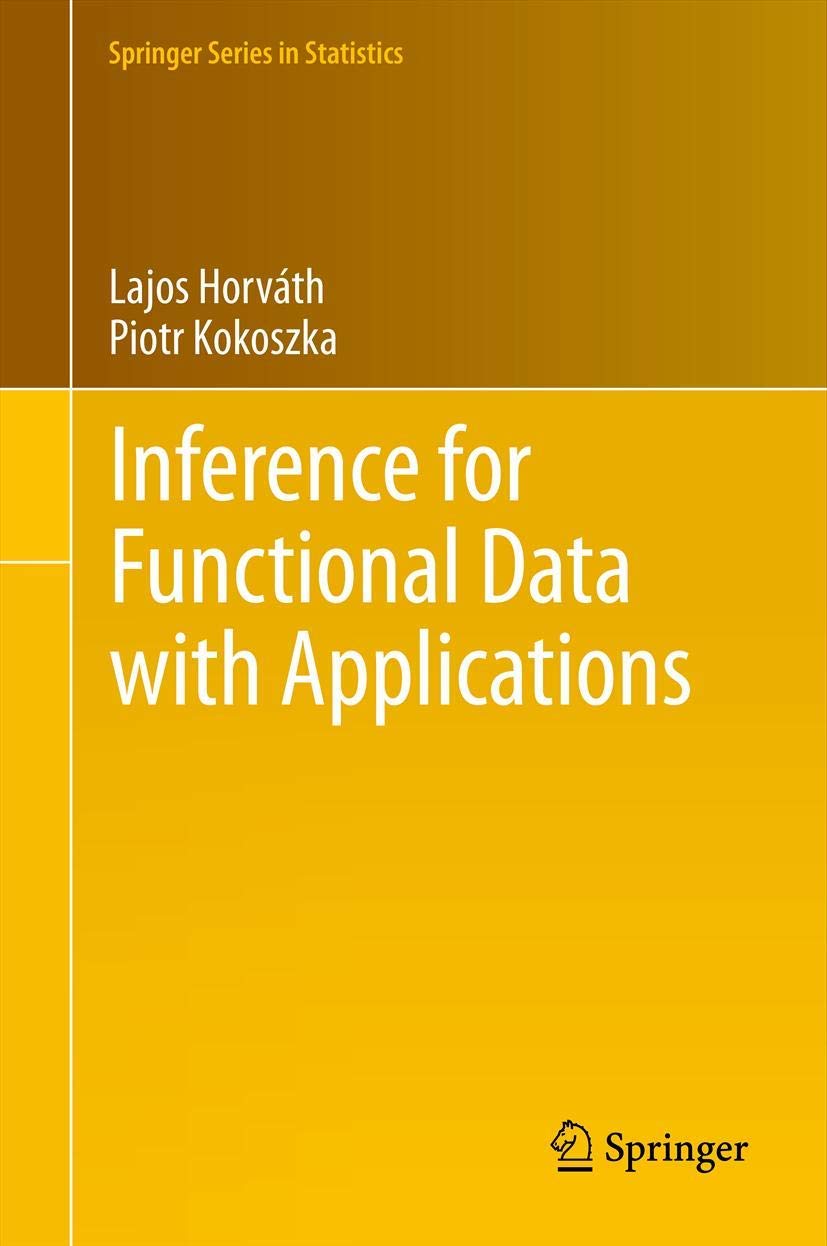
Inference for Functional Data With Applications: 200 (Springer Series in Statistics, 692)

Statistics
High-Dimensional Probability: An Introduction with Applications in Data Science (Cambridge Series in Statistical and Probabilistic Mathematics)

Statistics