
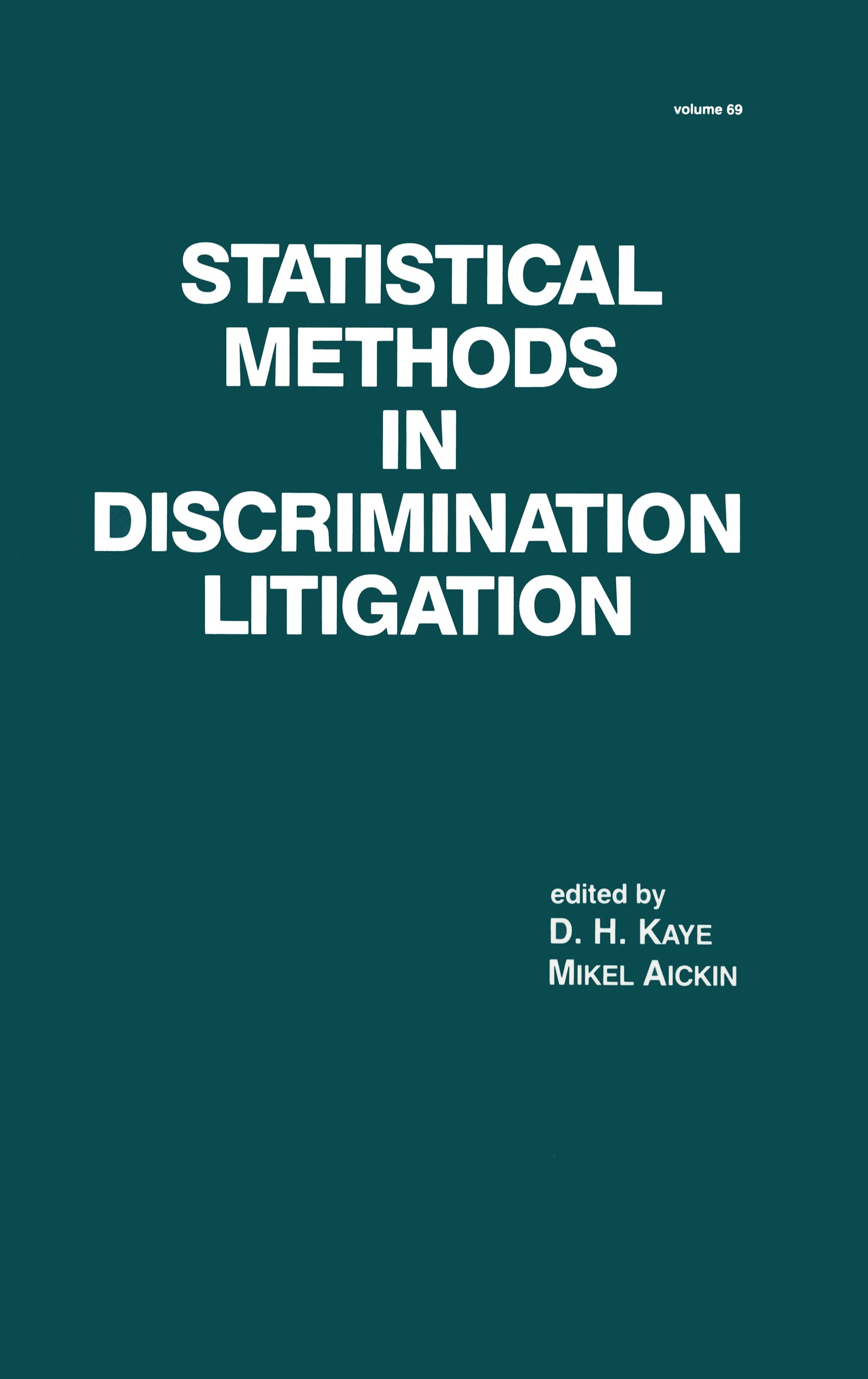
Statistical Methods in Discrimination Litigation: A Comprehensive Legal Statistics and Evidence Analysis Book by D. H. K
Inclusive of all applicable taxes. FREE shipping on all orders.
Available Offers
- 🚚Free Delivery — Free shipping on all orders
- 💵Cash on Delivery — Pay when your order arrives
- ↩️15-Day Easy Returns — Hassle-free return policy
- 🔒Cash on Delivery — Pay safely when your order arrives
Check Delivery
Product Description
Introduction
Statistical methods have become an indispensable tool in the courtroom, particularly in cases involving allegations of discrimination. In a legal landscape where data-driven evidence can make or break a case, understanding how statistics are applied and scrutinised is essential for lawyers, judges, and analysts alike. Statistical Methods in Discrimination Litigation, authored by the renowned legal scholar D. H. Kaye, offers a comprehensive and accessible guide to the intersection of statistics and anti-discrimination law. Published by CRC Press, this hardcover edition is an invaluable resource for Indian legal professionals, researchers, and students who wish to deepen their grasp of how quantitative evidence is used to prove or defend against claims of bias in employment, housing, education, and beyond.
Book Overview
This book provides a rigorous yet readable exploration of the statistical techniques most frequently encountered in discrimination lawsuits. D. H. Kaye, a leading expert in evidence law and scientific proof, demystifies complex statistical concepts and shows how they are applied in real-world litigation. The text carefully sketches the legal doctrines that underpin discrimination law and then examines the statistical methods that courts rely on to evaluate disparate treatment and disparate impact claims. From regression analysis to hypothesis testing, each method is explained with clarity and illustrated with case examples. This hardbound volume is designed to serve both as a textbook for advanced courses and as a practical reference for practitioners navigating the American legal system—with principles that are equally relevant to Indian anti-discrimination frameworks.
Key Highlights
- Authoritative Author: Written by D. H. Kaye, a distinguished professor and authority on evidence and statistics in law.
- Practical Focus: Bridges the gap between statistical theory and courtroom practice, with real case references.
- Comprehensive Coverage: Addresses both legal doctrines and quantitative methods used in discrimination litigation.
- Clear Explanations: Makes advanced statistical concepts accessible to readers without a deep mathematics background.
- Durable Format: Premium hardcover binding ensures longevity for repeated reference in academic or professional settings.
Inside the Book
Inside this meticulously crafted volume, readers will find a structured journey through the key statistical tools employed in discrimination cases. The book begins with an overview of relevant legal principles, including the burden of proof and evidentiary standards. It then delves into descriptive statistics, sampling methods, and the logic of statistical inference. Chapters on regression analysis, multiple regression, and logistic regression are presented with step-by-step guidance. The text also covers specialised topics such as the use of p-values, confidence intervals, and the assessment of statistical power. Each chapter includes illustrative examples drawn from landmark U.S. Supreme Court decisions, making the material concrete and immediately applicable. The appendices provide additional mathematical details for those seeking deeper theoretical understanding.
Key Topics
- Legal framework for discrimination claims: disparate treatment vs. disparate impact
- Fundamentals of probability and statistical inference
- Descriptive statistics and data visualisation in court
- Hypothesis testing: null and alternative hypotheses, p-values, significance levels
- Regression analysis: simple and multiple linear regression
- Logistic regression for binary outcomes
- Sampling techniques and survey design in litigation
- Statistical evidence for class certification
- Assessing causation and confounding variables
- Expert testimony and the admissibility of statistical evidence
Reader Benefits
By engaging with this book, readers will gain a solid foundation in the statistical reasoning that shapes discrimination litigation. Lawyers and judges will learn how to critically evaluate expert reports and deposition testimony. Law students will develop a competitive edge in courses on evidence, employment law, and forensic statistics. Social science researchers will understand how their quantitative work can be used—and challenged—in legal proceedings. The book also helps readers avoid common pitfalls, such as misinterpreting correlation as causation or overlooking sample bias. Ultimately, this text empowers its audience to use statistics not as a mysterious black box, but as a transparent and defensible tool for justice.
Learning Outcomes
- Understand the core legal concepts that govern discrimination cases in the United States and their parallels in Indian law.
- Interpret and apply basic statistical measures such as means, proportions, and standard deviations in a legal context.
- Conduct and critique hypothesis tests, including t-tests and chi-square tests, in discrimination claims.
- Build and interpret regression models to assess evidence of bias.
- Identify strengths and weaknesses of statistical arguments presented in court.
- Communicate statistical findings effectively to legal professionals and juries.
Who Should Read
This book is ideal for law students, practicing attorneys, judges, and legal academics who encounter statistical evidence in their work. It is also highly suitable for statisticians, data analysts, and social scientists who consult on litigation or wish to understand the legal standards that govern their analyses. For Indian readers, the principles discussed are directly transferable to cases under the Constitution of India, the Equal Remuneration Act, and other anti-discrimination statutes. Additionally, postgraduate students in law, criminology, and public policy will find this a valuable supplementary text for courses on empirical legal studies or quantitative methods.
About the Author
D. H. Kaye is a Regents Professor at the Sandra Day O'Connor College of Law, Arizona State University, and a leading figure in the field of scientific evidence. He has authored numerous books and articles on statistics, forensic science, and the law of evidence. His work has been cited by the U.S. Supreme Court and federal appellate courts. With a background in both law and statistics, Professor Kaye brings a unique interdisciplinary perspective that makes complex topics accessible and engaging.
About the Publisher
CRC Press, an imprint of Taylor & Francis Group, is a premier publisher of scientific, technical, and medical books worldwide. Known for its rigorous editorial standards, CRC Press has been a trusted source for high-quality reference works in statistics, engineering, and law. This hardcover edition reflects the publisher's commitment to producing authoritative and durable texts for professionals and academics.
Conclusion
Statistical Methods in Discrimination Litigation is more than a textbook—it is a bridge between two demanding disciplines. In an era where data increasingly influences judicial outcomes, this book equips readers with the analytical skills needed to navigate the complexities of discrimination law. Whether you are a student preparing for a career in litigation or a seasoned professional seeking to refine your expertise, D. H. Kaye's masterful work will serve as a trusted companion. Order your copy from Bookshops.in today and add this essential volume to your library.
Quick Summary
Statistical Methods in Discrimination Litigation by D. H. Kaye is a seminal work that bridges the gap between quantitative analysis and legal reasoning in the context of US discrimination law. The book systematically explains how statistical techniques such as regression analysis, hypothesis testing, and confidence intervals are employed as evidence in courtrooms, particularly in cases involving employment discrimination, civil rights, and equal protection. It delves into key legal doctrines like disparate impact and disparate treatment, illustrating them with landmark Supreme Court rulings. This book is ideal for law students, practicing attorneys, judges, and statisticians who wish to understand the role of data in litigation. Readers will learn to critically evaluate statistical arguments, understand burden of proof standards, and apply quantitative methods to real-world legal problems. Published by CRC Press, this hardcover edition is a durable addition to any legal library. By purchasing from Bookshops.in, Indian customers receive authentic copies with prompt delivery and reliable service, making it a trusted choice for academic and professional needs.
Book Highlights
Book Specifications
| ISBN-13 | 9780824775148 |
| ISBN-10 | 0824775147 |
| Publisher | CRC Pr I Llc |
| Language | English |
| Dimensions | 15.09 x 2.03 x 23.42 cm |
| Weight | 544 g |
| Category | Mathematics › Statistics |
| Genre | Law & Legal Reference |
| Original Language | English |
Frequently Asked Questions
What is Statistical Methods in Discrimination Litigation about?
Who is the author of this book?
Is this book suitable for Indian law students?
What statistical methods are covered?
Does the book include case studies?
Who should read this book?
Is this a hardcover edition?
What is the ISBN?
Can I use this book for my law dissertation?
Does the book cover Indian discrimination law?
Is the language easy to understand?
What is the price of this book?
Why buy from Bookshops.in?
Readers Also Search For
Customers Also Bought
Mathematics
Stereotype Spaces and Algebras: 73 (De Gruyter Expositions in Mathematics, 73)
Mathematics
Semigroups in Algebra, Geometry and Analysis: 20 (De Gruyter Expositions in Mathematics, 20)
Mathematics
Geometry from the Pacific Rim: Proceedings of the Pacific Rim Geometry Conference held at National University of Singapore, Republic of Singapore, ... 1994 (De Gruyter Proceedings in Mathematics)
Mathematics
First International Tainan-Moscow Algebra Workshop: Proceedings of the International Conference held at National Cheng Kung University Tainan, Taiwan, ... 1994 (De Gruyter Proceedings in Mathematics)
Mathematics
Differential Geometry - Proceedings of the VIII International Colloquium (English, Jesus A. Alvarez Lopez | Eduardo Garcia-Rio)
Mathematics
Mathematical Theory of Optimal Processes (Classics of Soviet Mathematics)
Related Products
View All
Statistics
Asymptotics in Statistics and Probability: Papers in Honor of George Gregory Roussas

Statistics
Inequalities in Analysis and Probability: 3rd Edition
Statistics
Random Graphs, Geometry and Asymptotic Structure
Statistics
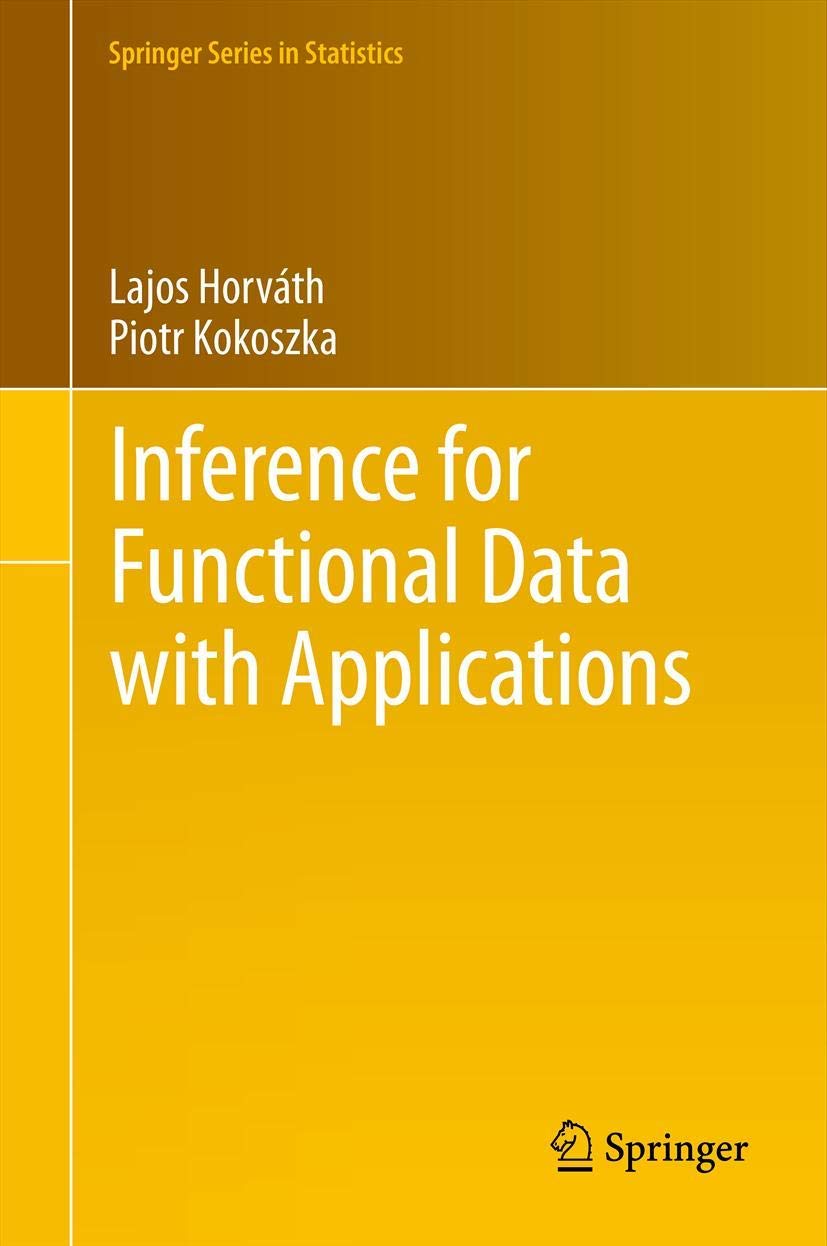
Inference for Functional Data With Applications: 200 (Springer Series in Statistics, 692)

Statistics
High-Dimensional Probability: An Introduction with Applications in Data Science (Cambridge Series in Statistical and Probabilistic Mathematics)

Statistics