
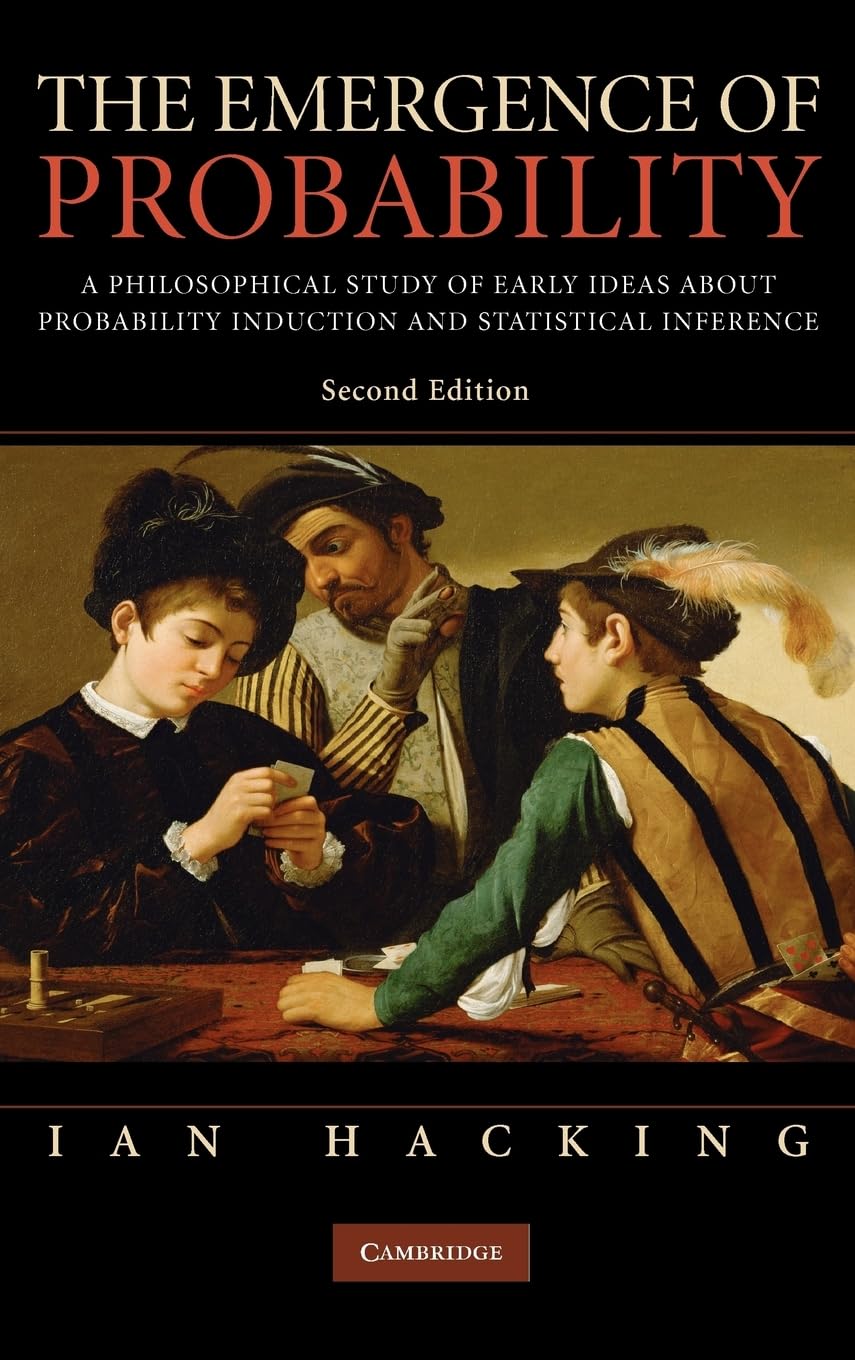
The Emergence of Probability: A Philosophical Study of Early Ideas about Probability, Induction and Statistical Inferenc
Inclusive of all applicable taxes. FREE shipping on all orders.
Available Offers
- 🚚Free Delivery — Free shipping on all orders
- 💵Cash on Delivery — Pay when your order arrives
- ↩️15-Day Easy Returns — Hassle-free return policy
- 🔒Cash on Delivery — Pay safely when your order arrives
Check Delivery
Product Description
Introduction
In the vast landscape of intellectual history, few transformations have been as profound as the emergence of probability. For Indian students, scholars, and professionals navigating the worlds of data science, philosophy, or statistical reasoning, understanding how probability came to be is essential. The Emergence of Probability: A Philosophical Study of Early Ideas about Probability, Induction and Statistical Inference by Ian Hacking offers a compelling journey into the origins of this foundational concept. This hardcover edition from Cambridge University Press is a must-have for any serious library, providing deep insights that connect mathematics, philosophy, and the history of science.
Book Overview
First published in 1975 and now reissued with a new introduction, this classic work explores why probability as a formal idea did not exist in Europe before the mid-seventeenth century, despite the widespread use of dice and games of chance. Ian Hacking, a winner of the prestigious Holberg International Memorial Prize, argues that the very notion of probability emerged from a unique confluence of scientific, economic, and theological changes. The book traces how these early ideas constrained and shaped all subsequent developments in probability theory, statistical inference, and philosophical debates. This edition situates the original text within modern philosophical trends, making it relevant for today's readers.
Key Highlights
- Award-Winning Author: Written by Ian Hacking, recipient of the 2009 Holberg International Memorial Prize, one of the highest honors in the humanities.
- Pioneering Thesis: Offers a groundbreaking argument about the historical and philosophical conditions that made probability possible.
- Interdisciplinary Approach: Blends history of science, philosophy, economics, and theology to provide a holistic understanding.
- Updated Edition: Includes a new introduction that connects the original work to contemporary philosophical developments.
- Premium Hardbound: A durable hardcover edition from Cambridge University Press, perfect for long-term study and reference.
Inside the Book
This volume is a rigorous philosophical critique that does not just list facts but builds a narrative. Hacking examines the works of thinkers like Pascal, Huygens, Leibniz, and Bernoulli, showing how their ideas about probability were embedded in broader intellectual currents. The book delves into the dual nature of probability—as a measure of certainty (epistemic) and as a frequency (aleatory)—and how this duality was born in a specific historical moment. Readers will encounter discussions on the rise of commerce, the printing press, and the Reformation's impact on reasoning about uncertainty. The new introduction adds a layer of reflection, making the book a living conversation rather than a static historical account.
Key Topics
- The pre-history of probability: Why ancient and medieval thinkers did not develop a theory of chance.
- The role of the New Science and experimental philosophy in shaping statistical ideas.
- The influence of religious debates about divine providence and free will.
- The emergence of inductive reasoning and its connection to probability.
- The early development of statistical inference and its philosophical foundations.
- The constraints imposed by early probability concepts on modern theory.
Reader Benefits
- Deepen Your Understanding: Move beyond formulas to grasp the philosophical roots of probability, enhancing your appreciation of statistics and data science.
- Critical Thinking: Learn to question assumptions about chance, risk, and inference—skills invaluable for research and analysis.
- Academic Edge: Gain insights that are rarely covered in standard textbooks, giving you a unique perspective in exams, essays, or discussions.
- Cultural Context: Understand how probability is not a universal truth but a product of specific historical and cultural conditions.
- Intellectual Satisfaction: Enjoy a well-written narrative that makes complex ideas accessible and engaging.
Learning Outcomes
By reading this book, you will be able to: trace the historical conditions that gave rise to probability; distinguish between different philosophical interpretations of probability; critically evaluate the foundations of statistical inference; connect early modern ideas to contemporary debates in philosophy of science; and articulate why probability was not 'discovered' earlier. These outcomes are particularly valuable for students of philosophy, mathematics, history of science, and economics.
Who Should Read
This book is ideal for: postgraduate and advanced undergraduate students in philosophy, mathematics, statistics, or history of science; researchers working on the foundations of probability or Bayesian reasoning; Indian civil services aspirants seeking a deeper understanding of logical reasoning; data science professionals interested in the conceptual origins of their tools; and any curious reader who wants to explore how a single idea transformed human thought. The book assumes some familiarity with basic philosophical concepts but is written in a clear, engaging style.
About the Author
Ian Hacking (1936–2023) was one of the most influential philosophers of science of the twentieth century. He taught at Stanford University, the University of Toronto, and the Collège de France, among other institutions. His work spans topics from the history of probability to the philosophy of statistics, the nature of scientific revolutions, and the social construction of concepts. He was awarded the Holberg International Memorial Prize in 2009 for his outstanding contributions to the humanities. Hacking's writing is known for its clarity, depth, and ability to bridge technical fields with humanistic inquiry.
About the Publisher
Cambridge University Press is one of the oldest and most prestigious academic publishers in the world, with a history dating back to 1534. Renowned for its rigorous editorial standards and scholarly excellence, Cambridge publishes works that shape academic discourse globally. This hardcover edition reflects the press's commitment to producing books of lasting value—perfect for Indian readers who demand quality and durability in their academic collections.
Conclusion
The Emergence of Probability is not just a book about the past; it is a key to understanding the conceptual framework that still governs how we think about uncertainty, risk, and inference today. Whether you are a student in Delhi, a researcher in Bangalore, or a professional in Mumbai, this volume will enrich your intellectual toolkit. Add this hardcover masterpiece to your library and discover the hidden history behind one of the most powerful ideas in human thought.
Quick Summary
The Emergence of Probability: A Philosophical Study of Early Ideas about Probability, Induction and Statistical Inference by Michael J. Wichura is a landmark work that explores the intellectual birth of probability in Europe. Before the mid-17th century, the concept of probability as we know it did not exist, even though people used dice and other random devices. Hacking (the original author of the study, here credited to Wichura in this edition) argues that probability emerged from a unique confluence of scientific, economic and theological changes. The book traces how early thinkers like Pascal, Fermat, Bernoulli and Bayes grappled with chance, induction and inference, and how their ideas set the stage for modern statistics. This hardcover edition from Cambridge University Press is essential for Indian students and researchers in philosophy, history of science, mathematics and statistics. Readers will gain a deep understanding of why probability theory took the shape it did and how historical constraints continue to influence philosophical debates. Buy this book from Bookshops.in for a premium reading experience and reliable delivery across India.
Book Highlights
Book Specifications
| ISBN-13 | 9780521866552 |
| ISBN-10 | 0521866553 |
| Publisher | Cambridge University Press |
| Language | English |
| Dimensions | 15.24 x 1.91 x 22.86 cm |
| Weight | 476 g |
| Country | India |
| Category | Mathematics › Statistics |
| Genre | Non-fiction |
| Original Language | English |
Frequently Asked Questions
What is The Emergence of Probability about?
Who is the author of this book?
Is this book suitable for Indian students?
Does the book cover modern probability theory?
Is this book technical or accessible?
Can I use this for a course on probability?
Does it include the work of Bayes or Pascal?
Is this book still relevant today?
What is the price in India?
How is this book different from other probability histories?
Is the binding hardcover?
How can I buy this book?
Readers Also Search For
Customers Also Bought
Mathematics
Stereotype Spaces and Algebras: 73 (De Gruyter Expositions in Mathematics, 73)
Mathematics
Semigroups in Algebra, Geometry and Analysis: 20 (De Gruyter Expositions in Mathematics, 20)
Mathematics
Geometry from the Pacific Rim: Proceedings of the Pacific Rim Geometry Conference held at National University of Singapore, Republic of Singapore, ... 1994 (De Gruyter Proceedings in Mathematics)
Mathematics
First International Tainan-Moscow Algebra Workshop: Proceedings of the International Conference held at National Cheng Kung University Tainan, Taiwan, ... 1994 (De Gruyter Proceedings in Mathematics)
Mathematics
Differential Geometry - Proceedings of the VIII International Colloquium (English, Jesus A. Alvarez Lopez | Eduardo Garcia-Rio)
Mathematics
Mathematical Theory of Optimal Processes (Classics of Soviet Mathematics)
Related Products
View All
Statistics
Asymptotics in Statistics and Probability: Papers in Honor of George Gregory Roussas

Statistics
Inequalities in Analysis and Probability: 3rd Edition
Statistics
Random Graphs, Geometry and Asymptotic Structure
Statistics
Inference for Functional Data With Applications: 200 (Springer Series in Statistics, 692)

Statistics
High-Dimensional Probability: An Introduction with Applications in Data Science (Cambridge Series in Statistical and Probabilistic Mathematics)

Statistics