
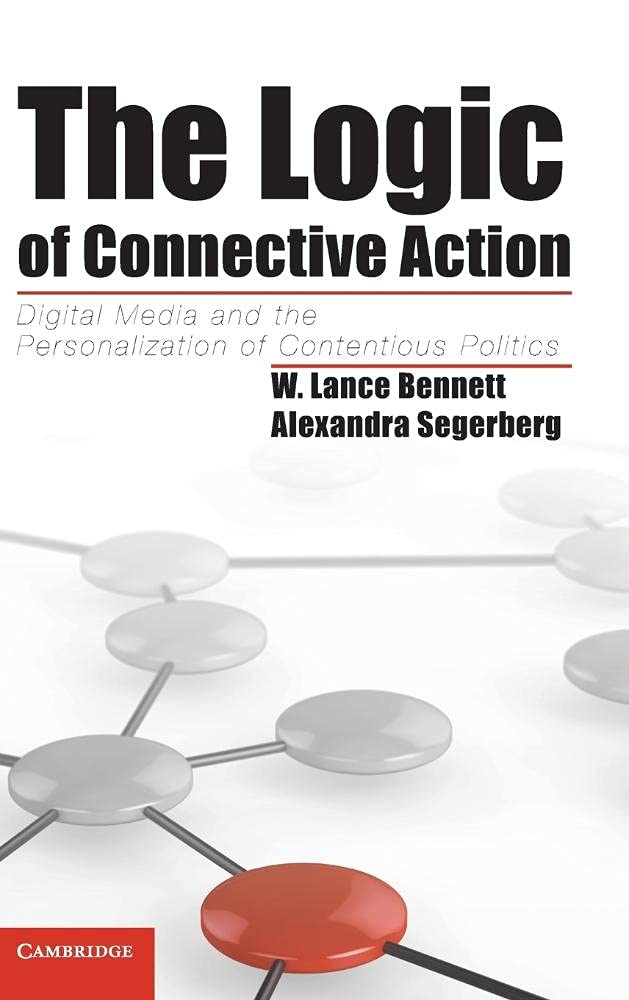
The Logic of Connective Action: Digital Media and the Personalization of Contentious Politics by W. Lance Bennett – A Ca
Inclusive of all applicable taxes. FREE shipping on all orders.
Available Offers
- 🚚Free Delivery — Free shipping on all orders
- 💵Cash on Delivery — Pay when your order arrives
- ↩️15-Day Easy Returns — Hassle-free return policy
- 🔒Cash on Delivery — Pay safely when your order arrives
Check Delivery
Product Description
Introduction
In an age where hashtags ignite movements and digital platforms reshape how we engage with politics, understanding the mechanics behind modern protest and civic participation is more crucial than ever. W. Lance Bennett’s The Logic of Connective Action: Digital Media and the Personalization of Contentious Politics offers a groundbreaking framework for making sense of today’s fluid, leaderless, and digitally orchestrated political mobilizations. Published by Cambridge University Press, this hardcover volume is an essential read for students, researchers, and anyone curious about the evolving relationship between technology and collective dissent.
Book Overview
This book delves into the rise of a personalized, digitally networked politics where individuals come together around shared concerns—from economic inequality to climate change—without the traditional scaffolding of formal organizations or charismatic leaders. Bennett introduces the concept of “connective action,” a paradigm where communication itself becomes the organizational force. Through rich case studies spanning the United States, the United Kingdom, and Germany, the author illustrates how large-scale coordination emerges from loose, digitally mediated ties. The book contrasts this with older models of collective action rooted in resource mobilization and institutional hierarchies, offering a fresh lens to view movements like Occupy Wall Street and global climate strikes.
Key Highlights
- Pioneering theory: Introduces the concept of “connective action” as a distinct logic from traditional collective action.
- Cross-national case studies: Examines real-world examples from the US, UK, and Germany, making the theory tangible.
- Focus on personalization: Explains how digital media enable individuals to engage politically on their own terms.
- Leaderless coordination: Analyzes how crowds self-organize without central leadership or formal structures.
- Rigorous academic foundation: Backed by Cambridge University Press, ensuring scholarly credibility and depth.
Inside the Book
The book is structured to first establish the theoretical framework of connective action, then apply it to diverse political contexts. Readers will explore how protest networks use digital platforms to channel resources, build solidarity, and sustain momentum. Bennett dissects the communication processes that replace or supplement traditional organizational roles, showing how personalized content—shared through social media—creates common ground among disparate individuals. The analysis extends to how established political organizations adopt these logics to scale engagement, blurring the lines between grassroots and institutional politics.
Key Topics
- Digital media and political participation
- Personalization of contentious politics
- Leaderless movements and self-organizing crowds
- Communication as organizational process
- Comparative study of protest in the US, UK, and Germany
- Economic fairness and climate change activism
- Resource mobilization versus connective action
Reader Benefits
This book empowers readers to decode the dynamics behind viral campaigns and spontaneous protests. It provides a vocabulary to discuss how digital tools reshape power, making abstract political shifts concrete. For activists, it offers insights into building resilient networks that thrive without top-down control. For scholars, it supplies a robust theoretical toolkit for analyzing contemporary social movements. Indian readers will find parallels with homegrown movements—from farmers’ protests to student-led climate action—and gain a deeper understanding of how technology enables collective voice in a diverse democracy.
Learning Outcomes
By the end of this book, readers will be able to: identify the key differences between collective and connective action; analyze the role of digital media in coordinating large-scale protests; evaluate how personalization affects political engagement; compare protest dynamics across different national contexts; and apply the connective action framework to real-world events. The book sharpens critical thinking about the intersection of technology, society, and governance.
Who Should Read
- Political science and sociology students seeking cutting-edge theory on digital activism.
- Media and communication researchers interested in the organizational power of networks.
- Activists and organizers aiming to understand modern protest mechanics.
- Policy makers and journalists who cover or influence public discourse.
- General readers curious about why some online movements become powerful forces for change.
About the Author
W. Lance Bennett is a distinguished professor of political science and communication at the University of Washington. A leading scholar in the fields of political communication and social movements, Bennett has authored numerous influential works on media, public opinion, and democracy. His research consistently bridges theory and practice, making complex political phenomena accessible to a wide audience.
About the Publisher
Cambridge University Press is one of the world’s oldest and most respected academic publishers. Known for its rigorous editorial standards and commitment to scholarly excellence, Cambridge brings authoritative works to readers globally. This hardcover edition reflects the press’s dedication to producing durable, high-quality books that serve as lasting resources for learning and reference.
Conclusion
The Logic of Connective Action is more than a book—it is a vital guide to the political language of our time. For Indian readers navigating a rapidly digitizing public sphere, Bennett’s insights offer clarity and context. Whether you are a student preparing for exams, a researcher building your bibliography, or an engaged citizen seeking to understand the forces shaping our world, this book belongs on your shelf. Order your copy from Bookshops.in today and step into the logic that drives modern change.
Quick Summary
The Logic of Connective Action by W. Lance Bennett is a seminal work that redefines how we understand political mobilisation in the digital age. The book argues that traditional collective action—reliant on formal organisations, leaders, and shared identities—is increasingly supplemented or replaced by 'connective action', where personalised communication via digital media coordinates large-scale protests. Using rich case studies from the United States, United Kingdom, and Germany, Bennett shows how movements like Occupy Wall Street harness media networks to create loose ties among diverse participants. The book is essential for students of political science, communication studies, and sociology, as well as activists and journalists. Indian readers will find the framework applicable to domestic movements such as the farmers' protests or climate activism. By buying from Bookshops.in, you get a genuine Cambridge University Press hardcover at a competitive price, delivered across India with reliable service.
Book Highlights
Book Specifications
| ISBN-13 | 9781107025745 |
| ISBN-10 | 1107025745 |
| Publisher | Cambridge University Press |
| Language | English |
| Dimensions | 15.88 x 2.54 x 24.13 cm |
| Weight | 570 g |
| Country | India |
| Category | Communication & Journalism › Communications |
| Series | Cambridge Studies in Contentious Politics |
| Genre | Political Science |
| Reading Age | 18+ |
| Original Language | English |
Frequently Asked Questions
What is the main argument of The Logic of Connective Action?
Who is the author of this book?
Which countries are covered in the case studies?
Is this book relevant for Indian readers?
What is the difference between collective action and connective action?
Does the book discuss the Occupy movement?
What is the ISBN-13 of this book?
Is this book available in hardcover?
What topics does the book cover?
Can this book help with UGC NET preparation?
What is the price of the book?
What is the language of the book?
Readers Also Search For
Customers Also Bought

McFarland & Company
Playing with the Guys | by Marc A. Ouellette | Matthew Wilhelm Kapell | McFarland & Company | by Marc A. Ouellette | Matthew Wilhelm Kapell | McFarland & Company | by Marc A. Ouellette | Matthew Wilhelm Kapell | McFarland & Company | by Marc A. Ouellette | Matthew Wilhelm Kapell | McFarland & Company | by Marc A. Ouellette | Matthew Wilhelm Kapell | McFarland & Company | by Marc A. Ouellette | Matthew Wilhelm Kapell | McFarland & Company | by Marc A. Ouellette | Matthew W

Rowman & Littlefield Publishers
Joss Whedon's Dollhouse: Confounding Purpose, Confusing Identity (Science Fiction Television)

State University of New York Press
Mexico Unmanned: The Cultural Politics of Masculinity in Mexican Cinema (SUNY series in Latin American Cinema)

McFarland & Company
Valley Forge to Monmouth | by Jim Stempel | McFarland & Company | by Jim Stempel | McFarland & Company | by Jim Stempel | McFarland & Company | by Jim Stempel | McFarland & Company | by Jim Stempel | McFarland & Company | by Jim Stempel | McFarland & Company | by Jim Stempel | McFarland & Company | by Jim Stempel | McFarland & Company | by Jim Stempel | McFarland & Company | by Jim Stempel | McFarland & Company | by Jim Stempel | McFarland & Company |

University of Toronto Press
Structures of Feeling in Seventeenth-Century Cultural Expression (UCLA Center Clark Library)

McFarland & Company
Welcome to Arkham Asylum | by Sharon Packer | Daniel R. Fredrick | McFarland & Company | by Sharon Packer | Daniel R. Fredrick | McFarland & Company | by Sharon Packer | Daniel R. Fredrick | McFarland & Company | by Sharon Packer | Daniel R. Fredrick | McFarland & Company | by Sharon Packer | Daniel R. Fredrick | McFarland & Company | by Sharon Packer | Daniel R. Fredrick | McFarland & Company | by Sharon Packer | Daniel R. Fredrick | McFarland & Company | by Sharon P
Related Products
View All
Cambridge University Press
Jane Austen and the Enlightenment (English, Peter Knox-Shaw)

Cambridge University Press
Children of the Queen's Revels (English, Lucy Munro)

Cambridge University Press
Site Automation | by Thomas Bock | Thomas Linner | Cambridge University Press | by Thomas Bock | Thomas Linner | Cambridge University Press | by Thomas Bock | Thomas Linner | Cambridge University Press | by Thomas Bock | Thomas Linner | Cambridge University Press | by Thomas Bock | Thomas Linner | Cambridge University Press | by Thomas Bock | Thomas Linner | Cambridge University Press | by Thomas Bock | Thomas Linner | Cambridge University Press | by Thomas Bock | Thomas Linner | Cambridge Unive

Cambridge University Press
Complex Analysis | by Ian Stewart | David Tall | Cambridge University Press | by Ian Stewart | David Tall | Cambridge University Press | by Ian Stewart | David Tall | Cambridge University Press | by Ian Stewart | David Tall | Cambridge University Press | by Ian Stewart | David Tall | Cambridge University Press | by Ian Stewart | David Tall | Cambridge University Press | by Ian Stewart | David Tall | Cambridge University Press | by Ian Stewart | David Tall | Cambridge University Press | by Ian St
Cambridge University Press
Taming Intuition | by Kevin Arceneaux | Ryan J. Vander Wielen | Cambridge University Press | by Kevin Arceneaux | Ryan J. Vander Wielen | Cambridge University Press | by Kevin Arceneaux | Ryan J. Vander Wielen | Cambridge University Press | by Kevin Arceneaux | Ryan J. Vander Wielen | Cambridge University Press | by Kevin Arceneaux | Ryan J. Vander Wielen | Cambridge University Press | by Kevin Arceneaux | Ryan J. Vander Wielen | Cambridge University Press | by Kevin Arceneaux | Ryan J. Vander W

Cambridge University Press